There’s a special satisfaction in watching a dusty strip of earth transform into a clean, hard surface that will carry cars, boots, and years of memory. Whether you’re replacing a crumbling strip or creating a new approach to your home, Building a Concrete Driveway: From Excavation to Final Seal is a process that rewards planning, patience, and attention to detail.
Why choose concrete for your driveway?
Concrete is a durable, relatively low-maintenance material that handles heavy loads and resists rutting better than many alternatives. It’s especially appropriate where long service life and stiffness matter—think heavier vehicles, trailers, or frequent use during winter months.
Beyond utility, concrete offers an aesthetic range from plain broom finishes to colored, stamped, or textured surfaces. That versatility means a driveway can be an extension of your home’s style rather than an afterthought.
Finally, lifecycle costs often favor concrete over asphalt for long-term projects. You’ll pay more up front than for a basic asphalt job, but properly built concrete rarely needs the same frequency of full-depth repairs.
Planning, permits, and budgeting
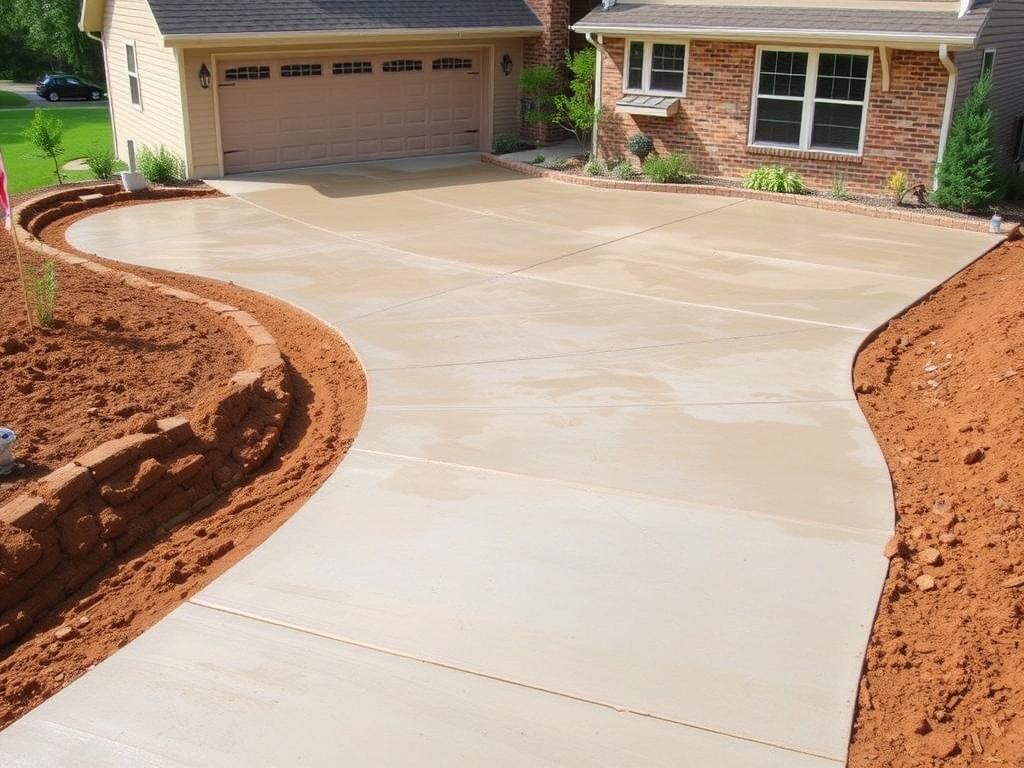
Start with a realistic budget that includes materials, delivery, labor, drainage work, and a contingency for surprises. Excavation often reveals poor soils or roots that increase costs, so set aside at least 10–20% more than your initial estimate.
Check local building codes and HOA rules early. Some municipalities require permits for new driveways, and there may be setback or stormwater runoff requirements that affect design and cost.
Call your local utility locating service before breaking ground. Hitting an underground cable or pipe is dangerous and expensive to repair, and a simple one-call request will mark buried utilities for you.
Permits and inspections
Permit processes vary widely; some places only need a simple application, others require engineered drawings and graded plan approvals. Contact your municipal building department and ask what they require for residential driveways.
Inspections are typically tied to subgrade preparation and final completion. Scheduling inspections while you’re still on site avoids rework and keeps the project flowing.
Keep copies of permits and inspection reports in a folder with receipts and material tickets—these documents are useful when selling the home or scheduling future maintenance.
Design decisions: thickness, slope, drainage, and aesthetics
Concrete thickness depends on anticipated loads. For most single-family driveways, 4 inches is common for passenger cars, but 5 to 6 inches is advisable if you expect heavier vehicles or more concentrated loading.
Slope and drainage are critical. Aim for a minimum slope of 1% (about 1/8 inch per foot) away from the house to avoid water pooling or runoff toward foundations. Plan for gutters, curb drains, or swales if the driveway directs significant water flow.
Aesthetic choices—color, texture, edging, and joint layout—affect both appearance and cost. Decide early so those choices can be integrated into the formwork, joint plan, and finishing techniques.
Driveway layout and edge details
Sketch the driveway on paper and verify it on site with stakes and string. Confirm turning radii for larger vehicles and ensure sight lines are clear for safe ingress and egress on public roads.
Edge details such as a decorative border or integral curb can be formed at the same time as the slab. These features are easier to set up during initial formwork than to retrofit later.
Include ramps or transitions to meet neighboring walkways and garage thresholds. Smooth, well-thought transitions prevent tripping hazards and premature edge spalling.
Step-by-step site preparation and excavation
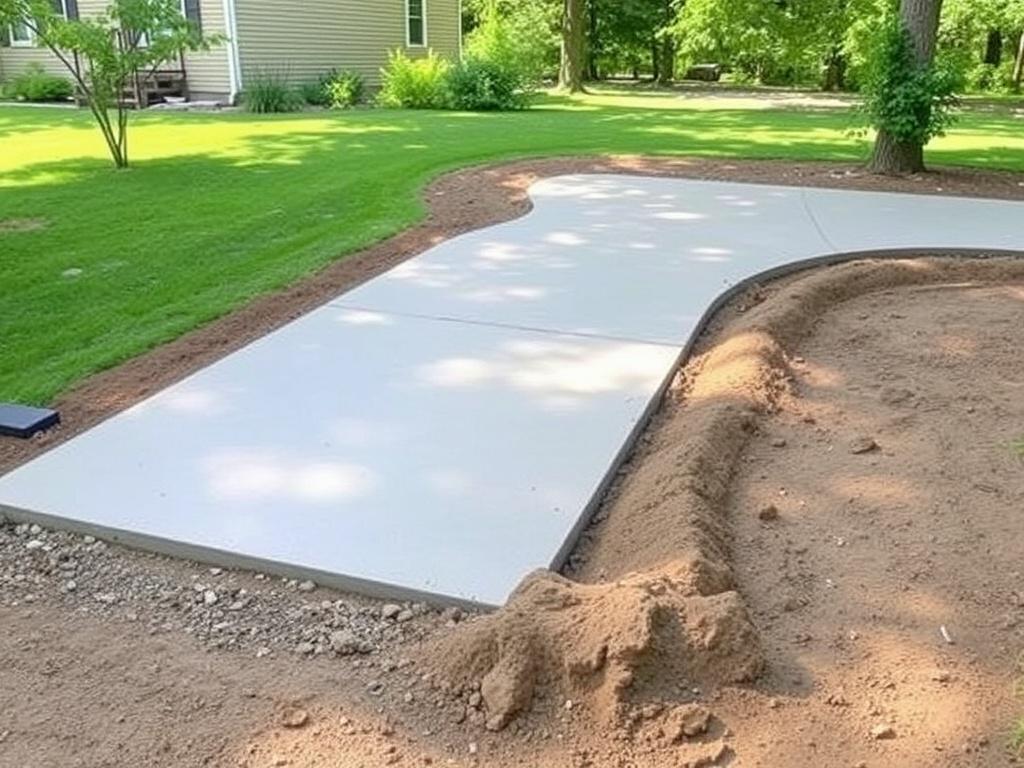
Start the physical work by stripping vegetation and topsoil to reach a stable subgrade. Organic topsoil compresses and shifts; removing it prevents future settlement of the slab.
Excavate to the depth required for your slab plus the subbase—commonly 4–6 inches of compacted aggregate under a 4-inch slab or deeper for heavier loads. Achieve a uniform depth and keep slopes consistent.
Remove large roots, boulders, and any weak or saturated soil layers. Occasionally you’ll encounter clay or peat that must be replaced with engineered fill to avoid long-term settlement problems.
- Mark and stake the perimeter and elevations.
- Strip topsoil and vegetation.
- Excavate to required depth for slab and subbase.
- Install sub-drain or grading features if necessary.
- Place and compact aggregate subbase in lifts.
Excavation depths and subbase table
Use consistent rules of thumb but adjust for local soil conditions and load expectations; a local geotechnical engineer can give definitive guidance for difficult sites.
| Use | Concrete thickness | Compacted aggregate subbase |
|---|---|---|
| Passenger cars | 4 in (100 mm) | 4–6 in (100–150 mm) |
| Light truck or RV traffic | 5–6 in (125–150 mm) | 6–8 in (150–200 mm) |
| Heavy loads | 6–8 in (150–200 mm) | 8–12 in (200–300 mm) |
This table is a starting point. If you have poor soils or a history of frost heave, plan for a thicker subbase or consult a professional.
Subbase and compaction
A well-compacted aggregate subbase distributes loads and minimizes frost heave and settlement. Use a crushed stone (3/4-inch minus) or #57 limestone that compacts well and drains freely.
Place the subbase in 2–4 inch lifts and compact each lift with a plate compactor or roller. Aim for at least 95% of maximum dry density as measured by a Proctor test for critical installations.
On sloped sites, add a geotextile fabric between the soil and aggregate to prevent migration of fines. Proper subbase preparation often makes the difference between a mistake-prone driveway and a long-lasting one.
Formwork: layout, bracing, and tolerances
Forms hold the concrete’s shape, so rigid, straight, and well-braced forms are essential. Use smooth, straight lumber and set the forms to the desired profile and slope using a laser level or string line.
Secure forms with stakes and bracing spaced closely enough to prevent blowout when the concrete is poured. Check form elevations along the length to maintain uniform slope and thickness.
Allow for slight overfill so the finishing process doesn’t leave low spots. The final screed will remove excess concrete, but solid forms keep edges crisp and edges from tearing out during finishing.
Edge treatments and chamfers
Chamfer strips create a small beveled edge that reduces chipping at slab edges and gives a neater look. Install them inside the form at the top edges before the pour.
Integral curbs or raised borders require additional formwork and bracing; make them part of your form setup to ensure uniform height and appearance.
For decorative grooves or patterns, incorporate jointed or keyed forms so finishes remain consistent and joints fall where intended.
Reinforcement and control joints
Reinforcement prevents sudden failure but does not eliminate cracking. Welded wire mesh or rebar is commonly used to bridge cracks and provide post-crack strength.
Place reinforcement near the slab’s mid-depth or slightly above mid-depth for best performance. Support bars on rebar chairs or mesh chairs to keep steel at the correct vertical position during the pour.
Control joints intentionally weaken the slab along planned lines so cracks form where you want them. Saw-cut joints are common; timing matters to avoid premature raveling.
Joint spacing and patterns
Rule of thumb: control joints spaced at intervals equal to 2 to 3 times the slab thickness in feet (e.g., 4-in slab: 8–12 ft spacing). Adjust spacing for temperature, aggregate type, and local experience.
Stagger or pattern joints in a way that complements the driveway’s layout and load paths. For wide driveways, arrange joints in a grid that prevents long unsupported spans between cuts.
Consider contraction (control) joints, expansion joints at rigid obstacles, and isolation joints where the slab meets structures or dissimilar materials to accommodate movement.
Concrete mix selection and ordering
Choose a mix designed for driveways: generally 4,000 psi is a solid target for residential use in many climates. Increase strength for heavier loads or aggressive freeze-thaw regions.
Workability is measured by slump; keep it moderate for placement and finishing—too wet and the concrete will sag and separate, too dry and it will be hard to finish smoothly.
Admixtures like air entrainment are essential in cold climates to improve freeze-thaw durability. Retarders or plasticizers can help in hot weather or for long haul times from the plant.
| Characteristic | Typical recommendation |
|---|---|
| Compressive strength | 3,500–4,500 psi |
| Air content (if freeze-thaw) | 6% ± 1.5% |
| Slump | 3–4 inches (for broom finish) |
Order a little extra—typically 5–10%—to account for waste, loss in pump lines, or slight over-excavation. Batch tickets and mix sheets are important records of what was placed.
Pouring concrete: logistics and crew coordination
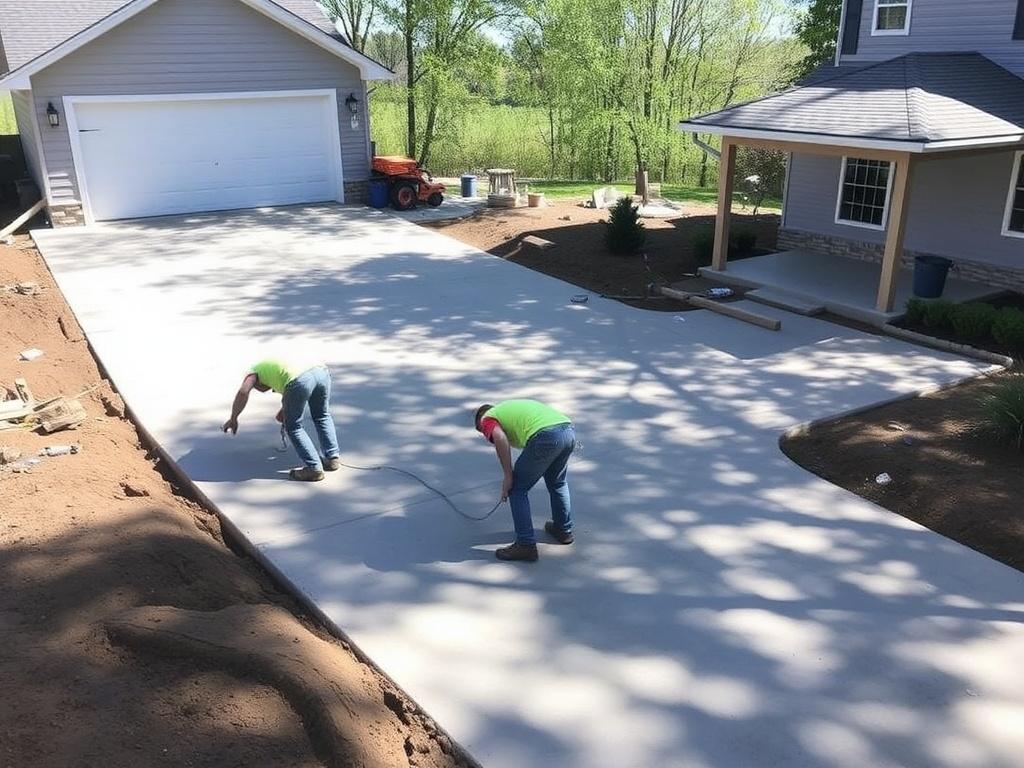
Plan the pour like a small operation: know truck arrival windows, pump locations if needed, and crew responsibilities. A steady, organized process avoids cold joints and rushed finishing.
Have all tools, edging, floats, and finishing equipment staged before the first truck arrives. Concrete begins to set; delays lead to uneven textures and excessive handwork.
Communicate the sequence: who handles raking and shoveling, who takes the screed, who floats and finishes. Clear roles reduce overlap and speed the process.
Handling large pours and cold joints
For large driveways, pour in lanes or bays and place joints where needed to manage the pour size. Cold joints occur when newly placed concrete meets concrete that has already stiffened; plan placements so these joints fall at control joint lines.
If a cold joint is unavoidable, create a keyed joint or roughen the surface and use bonding agents as recommended to improve shear transfer.
Keep weather in mind; high winds, heat, or rain change set times and surface appearance. Have tarps and water available to protect fresh concrete from sudden conditions.
Finishing techniques: from screeding to texture
After screeding to the correct elevation, bull-floating smooths high and low spots and brings cream to the surface for easier finishing. Don’t overwork; too much troweling seals water in the surface and weakens it.
Broom finishes are the most common for driveways because they provide slip resistance. A consistent broom stroke creates texture without looking messy—practice on a small patch if you’re new to the technique.
For decorative options like stamping or exposed aggregate, coordinate with the finishing timeline and special tools. These techniques require specific timing and skilled hands for a professional look.
Timing your finishing operations
Timing is everything: the concrete must be firm enough to hold texture but not so stiff that finishing becomes impossible. Use the bleed-water phase as a guide—finish after bleed water dissipates but before the concrete hardens.
In cool weather, finishing windows lengthen; in hot weather, they compress. Additives like retarders slow setting time when needed; cooling measures and shade help in hot climates.
Final edging and joint tooling happen shortly after the initial finish; get them done before the surface dries and edges begin to crumble.
Curing and early protection
Curing is the single most important step for long-term strength and durability. Keep concrete moist and at a stable temperature for at least seven days for typical mixes, longer for higher cement contents or cold weather pours.
Methods include wet burlap, plastic sheeting, or liquid curing compounds. The compound is convenient on driveways because it’s sprayed on and reduces water loss while allowing traffic to be restricted only for a few days.
Protect the slab from traffic, chemical spills, and freezing during the early cure period. Blocking off the driveway and putting up warning signs prevents costly damage from a well-intentioned car or delivery truck.
Control joint cutting and timing
Saw-cut control joints create a weakened plane that encourages cracking along a planned line rather than randomly. Cut timing typically falls between 4 and 18 hours after finishing depending on conditions.
Cut too early and the saw will ravel the edge; cut too late and the crack may already have formed. Monitor slab set and weather to choose the right hour for sawing.
Joints should be cut to at least one-quarter of the slab depth. For a 4-inch slab, that’s about 1 inch deep; deeper cuts are often better to ensure controlled cracking.
Sealing: when, how, and what to use
Sealers protect concrete from oil stains, deicing salts, and water infiltration that can accelerate freeze-thaw damage. Wait until concrete has cured for at least 28 days before applying most topical sealers for best penetration and performance.
There are two main types of sealers: topical (film-forming) and penetrating. Topical sealers provide a sheen and color enhancement; penetrating sealers preserve look and reduce chloride ingress without changing appearance much.
Apply sealers on a clean, dry surface with a sprayer or roller, following manufacturer instructions for coverage and number of coats. Reapply every 2–5 years depending on product, climate, and wear.
- Clean the slab: pressure-wash and remove stains.
- Allow drying time: 48 hours or longer depending on humidity.
- Apply sealer in thin, even coats with overlap.
- Let each coat dry fully before allowing traffic.
Choosing the right sealer
In coastal or salt-using regions, a penetrating silane/siloxane sealer reduces chloride penetration and helps prevent scaling. For decorative driveways, a solvent-based acrylic may enhance color while providing reasonable wear resistance.
Avoid cheap sealers that trap moisture or peel in a year; invest in a quality product and follow manufacturer application rates. A well-chosen sealer improves longevity and saves money over the life of the slab.
Sealers can darken concrete slightly; test on a small area to confirm appearance before treating the entire driveway.
Common problems and troubleshooting
Cracking is inevitable to some degree, but patterns tell a story: random hairline cracks near the surface often result from plastic shrinkage, while wide, irregular cracks may indicate poor subgrade or inadequate reinforcement.
Spalling or surface scaling often comes from freezing and thawing with saline exposure or from early-season deicing chemicals. Air-entrained concrete and adequate curing help prevent these issues.
Edge failure usually traces back to poor formwork, insufficient thickness at the edges, or lack of doweling into adjacent slabs. Strengthening edge details at the start prevents many repairs later.
Repair options
Small cracks can be sealed with caulk or routed and sealed, while larger issues may require partial slab replacement or concrete overlays. Evaluate the cause—fixing symptoms without addressing a bad subgrade is a short-term solution.
Surface repairs such as patching can restore appearance, but ensure materials are compatible with the original concrete to avoid color and bond problems.
For recurring or widespread issues, consult a structural or geotechnical engineer—they’ll help identify systemic causes and suggest durable repairs.
DIY versus hiring a professional
A small-scale driveway repair or a 2-car driveway for an experienced DIYer can be manageable. Tasks like forming, pouring, and finishing require skill; mistakes are visible and can be costly to fix.
Where complexity rises—poor soils, steep slopes, long runs, or significant drainage needs—hiring an experienced contractor often pays off. Professionals bring equipment, experienced crews, and the ability to manage scheduling and inspections.
Obtain multiple bids, check references, and ask to see recent, completed driveways. A good contractor will explain choices and stand behind their work with a warranty.
Questions to ask a potential contractor
- Are you licensed and insured for this type of work?
- Do you handle permits and inspections, and will you provide documentation?
- Can you show examples of similar jobs and provide references?
Also inquire about the mix designs they use, expected cure and sealing timelines, and how they handle unexpected subsurface conditions.
Estimated timeline and typical costs
Timeline varies with weather, size, and complexity. A straightforward residential driveway can take from 3 to 7 days of on-site work: excavation and base prep, formwork and reinforcement, one day pour and finish, and initial curing measures followed by sealing after 28 days.
Costs depend on region, concrete thickness, reinforcement, and finishes. Material and labor fluctuations mean a precise figure needs local quotes, but understanding typical cost drivers helps you budget.
| Item | Typical cost range (USD) |
|---|---|
| Excavation and grading | $500–$2,000 |
| Concrete (materials & delivery) | $4–$10 per sq ft |
| Reinforcement (mesh/rebar) | $0.50–$2.00 per sq ft |
| Finishing and sealing | $1–$4 per sq ft |
| Total installed | $6–$20 per sq ft (typical ranges) |
Regional labor rates and the complexity of access (narrow lots or long hose runs) can push prices to the higher end of these ranges.
Tools and materials checklist
Assemble the essentials before starting. For a typical driveway you’ll need excavation equipment or rental, plate compactor, form lumber and stakes, concrete screeds, bull float, magnesium float, broom, edger, jointer, and a saw for joints.
Consumables include tie wire, rebar chairs, curing compound, sealer, tie wires, and possibly plastic sheeting and burlap for curing. Safety gear—gloves, boots, eye protection, and hearing protection—protects you during intense work.
Renting a small concrete mixer isn’t usually necessary for driveway slabs; ready-mix delivery from a concrete plant with a pump or wheelbarrow setup is more efficient for most jobs.
Personal experience: a driveway that surprised me
On my first large driveway project, I underestimated the role of subbase compaction. The top looked perfect the day after the pour, but a heavy summer rain revealed a soft spot where a tree root had decayed.
We dug it out, added compacted stone, and repoured a patch. The lesson stuck: take time with the base—your slab will reward you. The repaired area is indistinguishable today because the subbase work was done right.
That experience shifted my priorities: more soil checks, more compaction, and a willingness to spend a little more on proper preparation rather than trying to fix problems later.
Long-term care and maintenance
Routine care keeps a driveway functional for decades. Clean spills promptly, avoid harsh deicers for young slabs, and reseal on the manufacturer’s recommended schedule.
Address small cracks quickly with appropriate fillers to prevent water infiltration and freeze-thaw damage. Replace severely spalled or sinking panels rather than repeatedly patching them; it’s often cheaper in the long run.
Good drainage is a maintenance priority—clear gutters and drains that serve the driveway to avoid water pooling and undermining the subbase.
Final walkthrough before opening to traffic
Before letting cars back onto a new slab, perform a final inspection. Check joints, surface texture, and edges for defects or debris that might cause issues.
Verify that curing and sealer schedules have been followed and document the date of the sealer application for future reference. Warn household members or tenants about weight and timing restrictions after pour.
A careful handoff with the homeowner’s maintenance notes and service records makes future care straightforward and protects the investment.
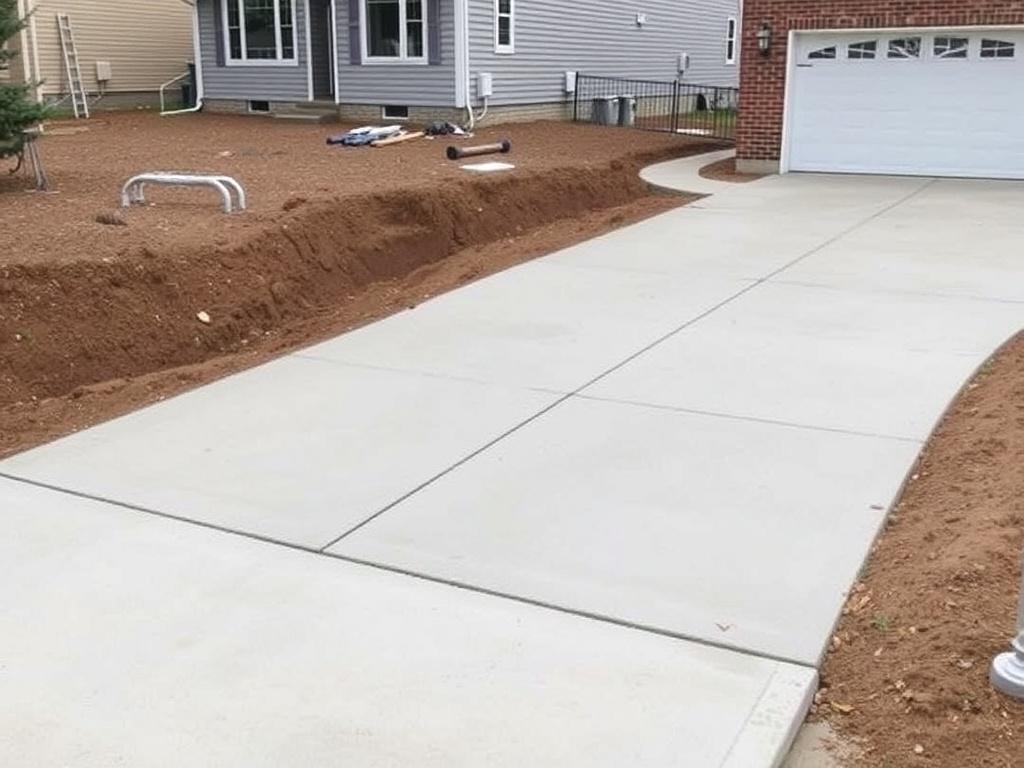
Building a concrete driveway is part planning, part earthwork, and part timing. When each stage—excavation, subbase, formwork, reinforcement, pouring, finishing, curing, and sealing—is executed with care, the result is a durable, attractive surface that serves for decades. With sensible choices, attention to detail, and proper maintenance, your driveway will be more than a place to park: it will be a reliable, attractive entry to your home for years to come.