Retaining walls do more than hold back soil; they create usable space, control erosion, and can transform a slope into a garden feature. Whether you’re tackling a small backyard terrace or a structural wall along a driveway, understanding the options — especially concrete block systems and poured concrete — is the foundation of a successful build. This guide walks through planning, materials, construction steps, and real-world tips so you can choose the right method and avoid the usual mistakes.
Why build a retaining wall?
Retaining walls manage changes in elevation, stabilize slopes, and protect foundations from soil movement. They also handle surface runoff, create level planting beds, and frame outdoor rooms, which increases usable property and curb appeal.
Beyond aesthetics, a well-designed wall prevents dangerous erosion and reduces the risk of landslides on steeper grades. Many homeowners discover that the cost of not installing a proper retaining wall — in the form of foundation damage or landscape failure — can be far higher than the investment in a durable structure.
Principles of retaining wall design
Lateral earth pressure and load considerations
Retaining walls resist lateral earth pressure created by the weight of soil behind them, which increases with depth. Design must account for the type of backfill, moisture content, and any surcharge loads like vehicles, fences, or buildings near the top edge.
Engineers often use simplified formulas for small DIY walls, but once the wall rises above a certain height or supports heavy loads, a structural engineer’s calculations are essential. Underestimating pressure is the most common reason walls bulge or fail prematurely.
Drainage and hydrostatic relief
Water is the enemy of a retaining wall because saturated soil exerts much higher pressure than dry soil. Providing an outlet for groundwater behind the wall — through drains, weep holes, and free-draining backfill — prevents hydrostatic pressure build-up that can push the wall outward.
Drainage systems are straightforward but must be continuous and maintained. A perforated drainpipe at the base wrapped in filter fabric and surrounded by clean gravel is the standard approach for both block and poured walls.
Frost, freeze-thaw, and soil movement
In cold climates, frost heave can lift footings and disturb walls if foundations aren’t placed below the frost line. Even in milder regions, freeze-thaw cycles can force water into cracks and expand them over time unless the wall is designed and detailed to resist moisture intrusion.
Soil type matters: clay expands and shrinks; sandy soils drain well but carry less lateral cohesion. Knowing your soil helps determine footing depth, backfill strategy, and whether a geotechnical report is necessary for taller structures.
Materials: concrete blocks and poured concrete
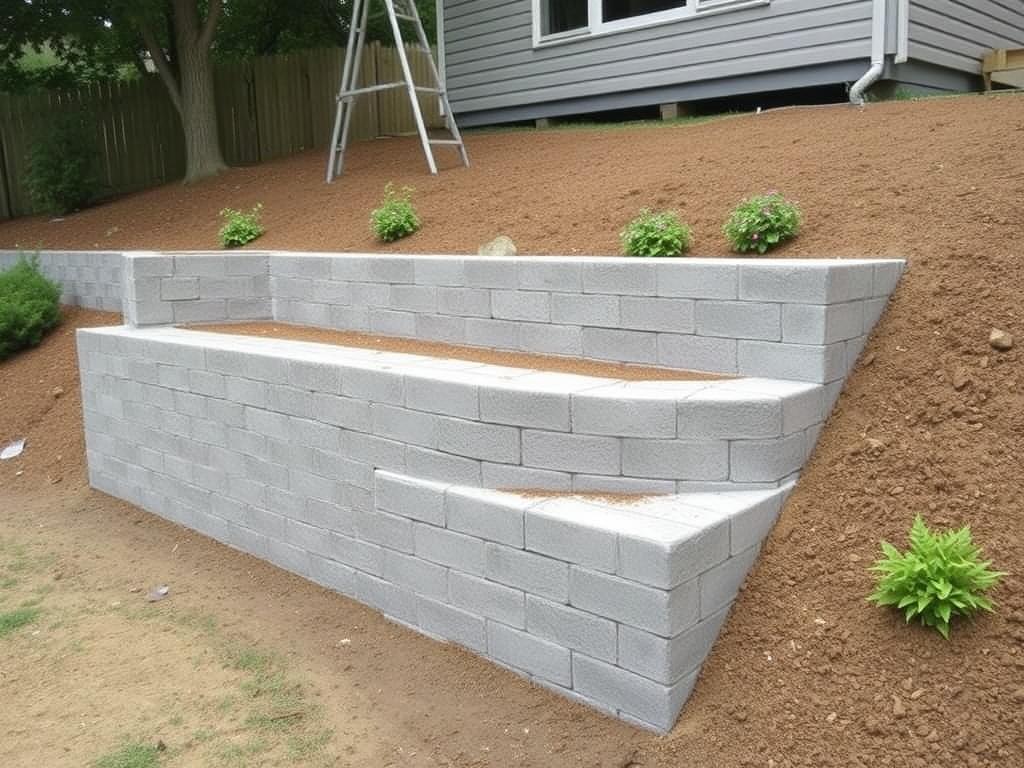
Concrete blocks: types and advantages
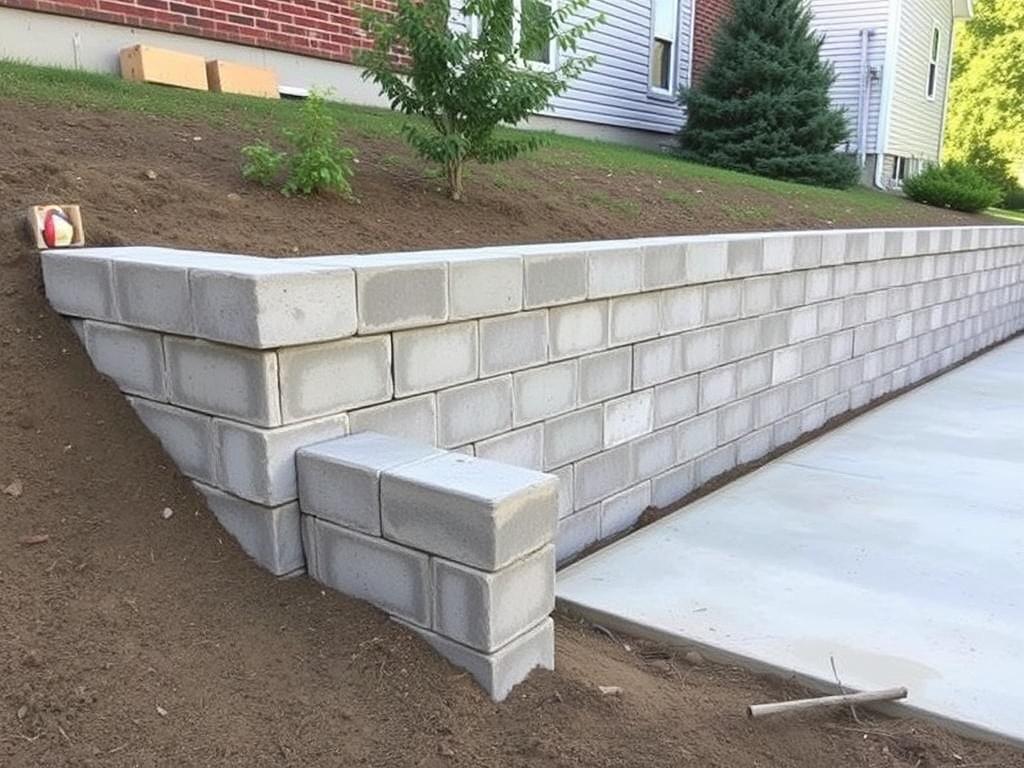
Segmental retaining wall (SRW) blocks are a popular choice for homeowners because they interlock and require no mortar. They come in a variety of sizes, finishes, and shapes, allowing for curved walls and decorative caps that look finished and professional.
SRW systems are forgiving: they can flex slightly with minor soil movement and are often quicker to install on smaller projects. Many blocks are manufactured with integral drainage channels or knuckles for grid reinforcement, which simplifies structural assembly for moderate heights.
Poured concrete: advantages and when to use it
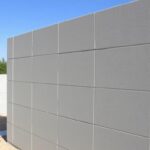
Poured concrete walls are monolithic structures that offer high strength and are ideal where a solid, engineered barrier is required. For tall walls, walls retaining heavy loads, or when a custom shape or architectural finish is needed, poured concrete is usually the preferred method.
With poured walls you can incorporate embedded footings, continuous reinforcing steel, and integrated waterproofing for a long-lasting system. The trade-offs are cost, the need for forms and concrete placement equipment, and less tolerance for post-construction movement without cracking.
Comparing block and poured concrete
Choosing between concrete blocks and poured concrete involves weighing cost, aesthetics, engineering requirements, and site constraints. The table below summarizes common differences to help match the method to the project.
| Criteria | Concrete block (SRW) | Poured concrete |
|---|---|---|
| Typical height range | Short to medium (up to about 4–8 ft without heavy reinforcement) | Short to very tall (with engineered design) |
| Installation complexity | Moderate; DIY-friendly with proper guidance | High; needs skilled crew and concrete placement |
| Flexibility | Good; blocks can be adjusted and releveled | Low; monolithic and less forgiving |
| Aesthetics | Many textures and finishes; easy to cap | Can be finished in many ways but needs more effort |
| Cost | Generally lower for smaller walls | Higher initial cost but durable for big jobs |
Planning and permits
Before breaking ground, check local codes and permit requirements; many jurisdictions require engineered drawings for walls over a certain height. Your municipality may also have setback rules, easement restrictions, or inspection schedules that affect your timeline.
Even when permits aren’t mandatory, it’s wise to involve an engineer for walls that will exceed four feet in retained height or support structural loads. A signed plan protects you and ensures your wall is stable, insurable, and compliant with neighboring property rights.
Site assessment and layout
Start by measuring the slope, noting drainage patterns, and marking utilities. Call 811 to locate buried lines — hitting a gas or electrical line can be deadly and will derail the project.
Mark the proposed wall line with stakes and string, and walk the site after rain to see where water naturally collects. This reconnaissance helps position drains and determine whether a retaining wall is the best solution or if terracing or regrading would be preferable.
Tools, materials, and suppliers
Gathering the right gear makes the job faster and cleaner. Typical tools include a plate compactor, level, string line, shovel, wheelbarrow, mason’s chisel for block trimming, concrete mixer for small pours, and appropriate safety equipment.
Materials vary by method: SRW blocks, caps, gravel for drainage and leveling, geogrid, filter fabric, and concrete for footings for block walls; and forms, rebar, concrete, ties, and waterproofing for poured walls. Rent heavy equipment for excavation if the job is large.
- Common tools: plate compactor, masonry saw, vibrator (for concrete), hand tamper.
- Common materials: 3/4″ crushed stone, 4″ perforated drainpipe, schedule 40 PVC for vents, geogrid, rebar, concrete mix.
Building a concrete block retaining wall: step-by-step
Excavation and footing preparation
Begin by excavating a trench for the leveling pad and footer. The depth depends on the wall height and frost line, but for many small SRW projects a 6–12 inch compacted crushed stone pad with a wider base than the wall is common practice.
A level, compacted base is more important than a perfectly poured concrete footing for many SRW systems, because the first course sets the geometry for the rest of the wall. Use a plate compactor and check the base frequently with a long level or laser to keep the wall true.
Building the leveling pad and first course
Set the first course of blocks into the compacted base; the first course establishes the entire wall’s alignment and pitch. Use a dead blow hammer to seat each block and check both horizontal and vertical levels for each unit.
Pay close attention to setbacks (batter) and alignment; many modular systems have factory-specified setbacks per course that provide passive stability. If the blocks need trimming for curves, use a masonry saw or chisel to avoid chip-out and maintain clean joints.
Backfill and drainage installation
As you place courses, install a perforated drainpipe at the wall’s base set on a bed of gravel toward a suitable outlet. Fill behind the wall with clean, free-draining gravel rather than native clay; compact in lifts to reduce settlement while avoiding compaction too close to the wall face to prevent bulging.
Filter fabric between the soil and the gravel prevents fines from clogging the drainage zone. For taller walls, tie the pipe to a visible daylight point or connect to a storm system per code.
Reinforcement with geogrid
Geogrid is often required for SRW systems when the retained height and loads exceed the block’s passive resistance. It extends soil reinforcement back into the retained mass, creating a composite structure that resists sliding and overturning.
Install geogrid at manufacturer-specified course levels and tension it as you install successive block courses. Overlapping and anchoring the geogrid properly is critical — loose or poorly anchored grid won’t perform as intended.
Capping and finishing touches
Capping units provide a finished look and a stable top surface for seating or planter beds. Set capstones with a construction adhesive or mortar designed for exterior use to resist freeze-thaw conditions and traffic.
Finish grading and plantings should direct surface runoff away from the wall. A planted swale above the wall or a permeable paving zone can help capture water before it reaches the backfill.
Building a poured concrete retaining wall: step-by-step
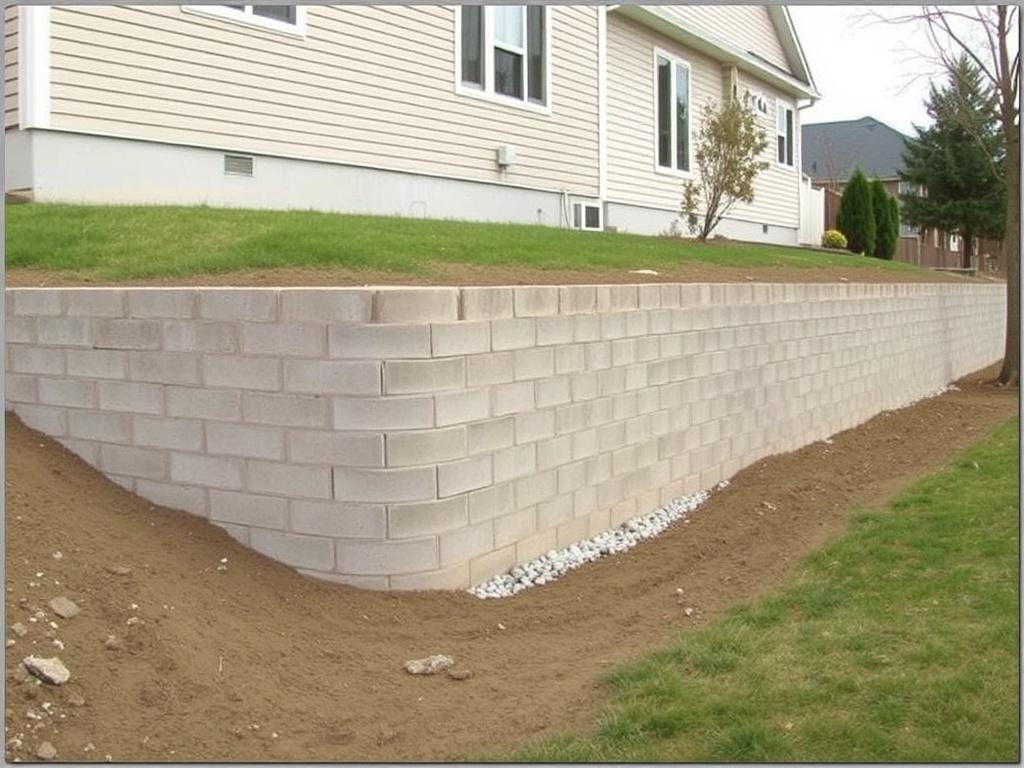
Formwork and footing excavation
Poured walls usually start with a reinforced concrete footing excavated below frost depth or per engineer specifications. Properly sized footings spread the wall thrust and are essential for longevity and preventing settlement.
Set formwork accurately because poured walls are unforgiving; slight misalignment in forms becomes a permanent defect. Use straight, sturdy form panels braced tightly to resist the pressure of wet concrete and to maintain consistent wall thickness.
Rebar layout and reinforcement
Rebar placement follows engineered drawings and ties the footing to the stem wall, providing tensile capacity that concrete lacks. Spacing, size, and lap lengths are prescribed based on height, load, and local building code.
Place chairs and supports to maintain the proper cover over the rebar, and ensure clear access for concrete placement. Gaps in the rebar mesh or insufficient anchorage reduce the wall’s ability to resist bending and shear.
Pouring, consolidating, and curing concrete
Pour concrete in lifts as specified, consolidating with vibrators to eliminate voids and honeycombing. Continuous pours reduce cold joints and strengthen the bond between footing and wall stem.
Curing is as important as placement; maintain moisture and temperature conditions for the duration specified by the mix design to achieve intended strength. Rapid drying can cause shrinkage cracking; a curing compound or wet burlap may be necessary in hot, dry conditions.
Waterproofing and protective finishes
Once forms are stripped, apply waterproofing membrane or drainage board to the back of the wall where soil contact is continuous. Proper waterproofing prevents migrating moisture and extends the service life of the concrete and any interior finishes.
Consider adding a drainage plane — a dimpled membrane — between the waterproofing and soil to channel water to the perimeter drain and reduce hydrostatic pressure. Final grading and planting should avoid directing concentrated runoff toward the wall face.
Common mistakes and troubleshooting
Poor drainage is the single biggest mistake; even a well-constructed wall can fail quickly if water is allowed to sit behind it. Install comprehensive drainage and maintain it over time to avoid surprises.
Another frequent error is insufficient footing or subgrade preparation. A settled base causes step-like displacement in block walls and can crack poured walls; take the time to compact and inspect subgrade conditions before building.
Over-reliance on visual alignment without checking plumb and level at every course can leave you with a wall that appears straight from one angle but leans where it matters. Use a long level, string lines, and a laser when precision matters.
Maintenance and long-term care
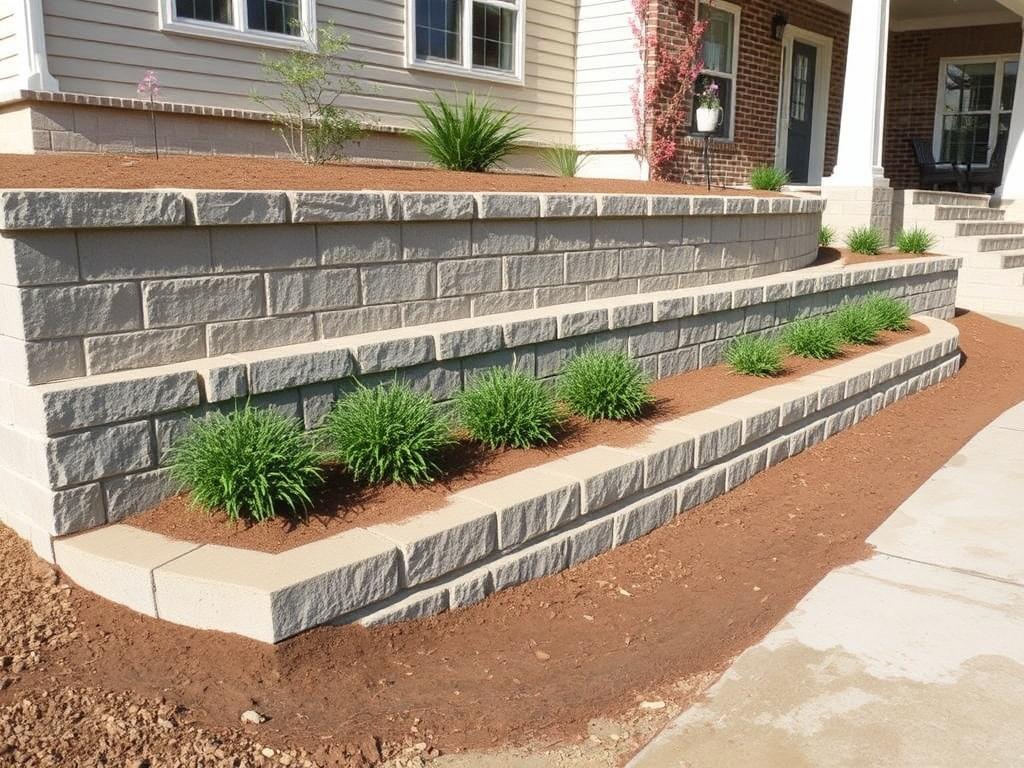
Routine inspection is inexpensive and effective: look for bulging, bowed blocks, cracks, pooling water, or plants rooted in the wall that can pry units apart. Catching problems early often allows for local repairs without reconstructing the wall.
Keep drains clear of sediment and plant roots, and repair cracked mortar or caulk in poured walls to prevent moisture entry. Replacing backfill near the surface with finer soils to support plants is fine, but keep the drainage zone intact behind the wall structure.
Cost, timeline, and when to hire a pro
Costs vary widely: a small DIY block wall might run a few hundred to a few thousand dollars depending on material and whether you rent equipment, while a professionally engineered poured wall can cost tens of thousands for significant heights. Labor dominates the cost for poured walls; block walls save on labor if you do it yourself and learn the system.
Timeline depends on size and weather. A modest block wall can be completed in days to a week with a small crew, while a poured wall involving engineered footings, forms, inspections, and curing may take several weeks from excavation to finish.
Hire a professional when the wall retains more than a few feet of soil, supports structures or traffic, or when local code requires engineered plans. Professionals bring knowledge of local soils, proper reinforcement, and a crew to efficiently place concrete and correct unforeseen issues on the fly.
Practical examples and real-life lessons
On a project I managed in a neighborhood with a steep backyard slope, we replaced an old timber wall with a two-tier SRW system. We used 4-inch drainpipe with geogrid reinforcement and staggered setbacks to create a planted terrace with a visual sense of depth and sturdiness.
One practical lesson from that job: we overexcavated the footing by only a few inches and ended up with a settled base after a storm because the contractor didn’t compact in lifts. The fix required removing several courses, recompacting, and rebuilding — time-consuming and avoidable with better QA during the first day.
On another job, a poured wall behind a small commercial building provided a clean, uniform façade and allowed us to integrate an embedded handrail and lighting conduit. We learned that coordinating trades early — waterproofing, electrical, and landscaping — saved retrofit costs later.
A short checklist for a successful wall
Before you start, run through a brief checklist to reduce surprises: mark utilities, secure permits, test soil if in doubt, design drainage, and decide whether geogrid or rebar is necessary. Confirm delivery times for materials and plan for weather contingencies.
- Confirm utilities are located and marked.
- Obtain required permits and inspections schedule.
- Prepare compacted subgrade and leveling pad.
- Install continuous drainage and filter fabric.
- Follow manufacturer or engineer specifications for reinforcement and backfill.
Finishes, plantings, and integrating the wall into the landscape
How a wall looks is nearly as important as how it functions. Capping units, color choices, and texture selection for block walls allow you to match existing architecture or create a contrast that highlights the wall as a feature.
Planting is both practical and aesthetic: deep-rooted shrubs placed away from the immediate drainage zone stabilize slopes above a wall, while shallow-rooted groundcovers soften the face. Avoid large trees near the foot of the wall unless they’re accounted for in the engineering plan.
When a hybrid approach makes sense
Some sites benefit from a hybrid strategy that combines poured concrete for the lower structural courses and block or stone veneer for the visible face. This approach gives the strength of poured concrete with the aesthetic flexibility of modular products.
Hybrid walls often arise when you need the structural capacity of poured concrete for the foundation or key bearing points but prefer the speed, modularity, or appearance of block above grade. Discuss options with a structural engineer and masonry contractor to ensure detailing between the two systems is watertight and compatible.
Environmental considerations and sustainable options
Consider the environmental impact of your material choices: locally produced blocks reduce transportation emissions, and using recycled aggregate in backfill can lower environmental footprint when permitted. Permeable finishes and planted terraces reduce runoff and promote groundwater recharge.
Native plants and rain gardens above a retaining wall can capture stormwater and filter runoff, reducing the load on municipal systems. Specify low-maintenance species that won’t compromise the drainage zone or root into the wall’s structure.
Repair techniques for minor failures
Small bulges in a block wall can sometimes be corrected by removing a limited number of courses, re-leveling the base, and reinstalling blocks with better drainage. For poured walls, hairline cracks can be sealed with epoxy or polyurethane injections to prevent moisture ingress.
Major failures often indicate a deeper problem with footing, subgrade, or drainage and usually require professional assessment. Avoid patching visible defects without investigating underlying causes; a cosmetic fix can hide a progressing collapse that becomes costlier later.
Final thoughts on choosing your method
Choosing between concrete block and poured concrete comes down to the scale of the job, budget, aesthetics, and long-term expectations. For small to medium walls that benefit from a decorative face and easier do-it-yourself installation, SRW blocks are an excellent option.
For higher walls, situations with heavy loads, or where a seamless, engineered solution is required, poured concrete is the safer route. Either way, prioritize drainage, proper footing, and quality materials — those elements determine whether the wall lasts decades or fails within a few seasons.
Building retaining walls with concrete blocks and poured concrete is both a craft and an engineering task; get the basics right, respect the forces at work, and your wall will serve both function and form for years to come. If you decide to attempt a DIY wall, start small, consult product guides and local codes, and don’t hesitate to call a pro for design or any sign of unexpected soil behavior.