
Every concrete element on a building — a beam, column, or slab — carries a story of forces, material behavior, and design choices. This article walks through the principles, calculations, and judgment calls involved in assessing how much load a concrete member can safely support. I’ll combine theory, design-code thinking, practical checks, and examples so you can both understand the formulas and apply them in real projects.
Understanding what “load-bearing capacity” means
Load-bearing capacity is the maximum load a structural element can carry without reaching an unsafe state, whether that state is crushing, buckling, excessive deformation, or brittle failure. For concrete members there are several potential limit states: flexural yield of reinforcement, concrete crushing in compression, shear or punching shear failure, and global instability for slender members. Distinguishing nominal capacity (a calculated value based on material strengths and geometry) from factored or design capacity (adjusted by strength reduction factors and compared to factored loads) is critical for safe design.
The capacity you calculate is only as good as the inputs: concrete compressive strength, steel yield strength, effective dimensions, and assumed load paths. Material variability, construction defects, and long-term effects such as creep and shrinkage can reduce capacity, so conservative code provisions and safety factors exist to cover uncertainties. In practice, checking several failure modes (flexure, shear, bearing, and stability) is standard; the lowest controlling capacity sets the safe limit.
Codes, factors, and why they matter
Design codes like ACI 318 (US), Eurocode 2 (Europe), and other national standards provide the framework for calculating capacities, specifying load combinations, and assigning strength reduction factors (phi). These codes are not just bureaucratic text — they reflect decades of testing, failure statistics, and consensus on acceptable uncertainty. Following a code ensures that the calculated capacity includes a calibrated margin to protect against material variation, modeling approximations, and unexpected loadings.
Typical strength reduction factors reduce nominal capacities to a design level; for example, phi is lower for shear and higher for flexure because of the different failure behaviors and predictability. Load factors (e.g., the factors applied to dead, live, and environmental loads) reflect the probability and consequences of overload. When you design or check an element, you compare factored loads (sum of loads times load factors) to the reduced capacity (phi times nominal capacity).
It’s good practice to confirm which edition of a code applies to your project and to be consistent throughout the design. Local amendments, seismic provisions, and exposure conditions also influence factors and detailing requirements. If the structure is older or built under a different code, conservative reinterpretation or retrofit design may be necessary to meet modern safety expectations.
Material properties: concrete and reinforcing steel
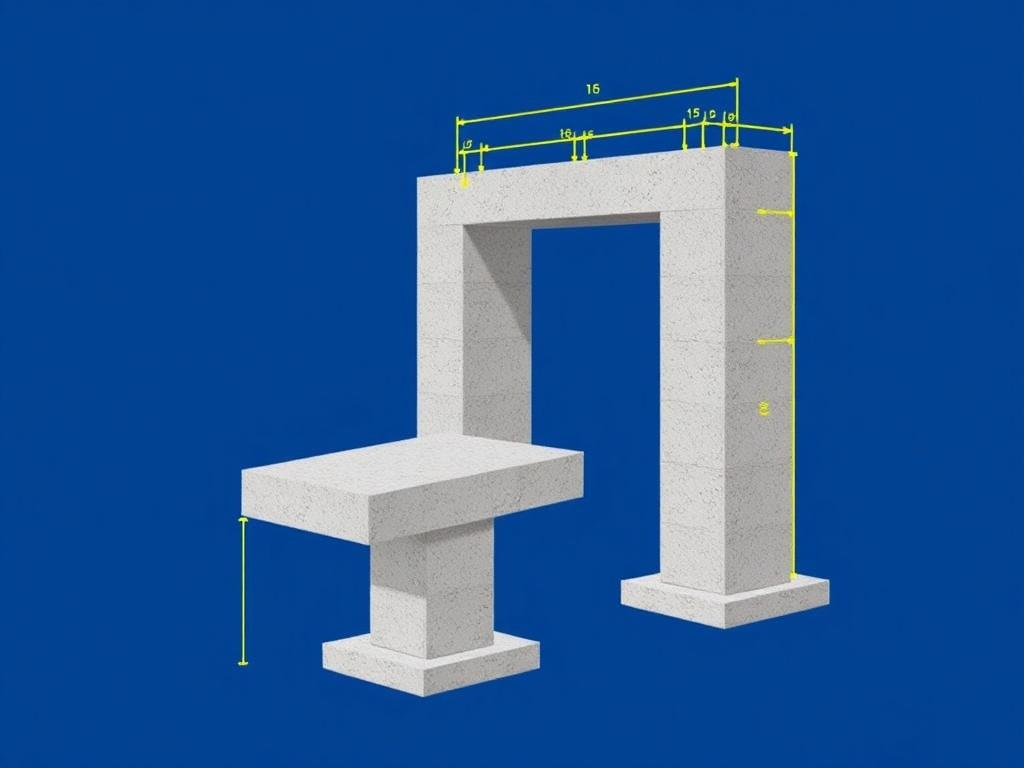
Concrete strength is summarized by f’c, the specified compressive strength at 28 days in psi (or MPa). That number governs many capacity expressions: higher f’c increases compressive capacity, stiffness, and shear resistance, but can change ductility characteristics. Reinforcing steel is described by yield strength, fy, and its ductility and bond behavior matter too; common grades are 40 ksi and 60 ksi in the United States.
Testing is essential to verify f’c and should be part of quality control. Standard cylinder tests (e.g., 6×12 in cylinders) are common in the U.S., but some regions use cubes. When assessing an existing structure, core testing or non-destructive evaluation is used to estimate actual strength for recalculations and retrofit design. Remember that curing, admixtures, aggregate type, and construction practices influence the achieved strength compared to the specified value.
Common reinforcement bar sizes and properties
Knowing rebar areas and typical yields makes hand calculations and sanity checks much faster. Below is a small table of common rebar sizes and their cross-sectional areas used in U.S. practice.
| Bar size | Area (in²) |
|---|---|
| #3 | 0.11 |
| #4 | 0.20 |
| #5 | 0.31 |
| #6 | 0.44 |
| #7 | 0.60 |
| #8 | 0.79 |
These areas let you quickly compute tensile steel contribution, determine required reinforcement, and feed basic capacity formulas. Keep rebar spacing and development length requirements in mind when translating area into workable layouts.
Types of loads and combinations to consider
At the simplest level, loads fall into dead loads (self-weight and permanent attachments), live loads (occupancy, movable loads), and environmental loads (wind, seismic, snow). Special loads such as impact, hydrostatic pressure, or thermal loads can be important in industrial or bridge work. Load combinations in codes multiply these individual loads with factors that reflect the probability of simultaneous extremes.
Seismic design will modify load combinations and often increase demand on ductility and detailing; wind design emphasizes lateral load resistance and connections. For an accurate capacity check you must use the applicable factored load combination and apply it consistently to all checks — axial, flexural, shear, and serviceability. Don’t forget load eccentricity, which converts pure axial loads into combined bending and axial demand.
Step-by-step: general procedure for checking a member
There is a repeatable workflow that reduces mistakes: (1) gather geometry, materials, and reinforcement; (2) determine load cases and factored loads; (3) identify relevant failure modes; (4) compute nominal capacities for each mode; (5) apply strength reduction factors; and (6) compare to factored loads and check serviceability. Doing the same steps in the same order helps you spot missing information or inconsistent units.
Document assumptions and reference the code clauses you used; this is essential for verification and future revision. If a calculated capacity is marginal, consider alternate solutions: more reinforcement, post-tensioning, larger section, or redistributing loads. Always cross-check with a simple hand calculation or a second reviewer for critical elements.
Flexural capacity of rectangular beams: the core calculation
Flexural design of reinforced concrete relies on strain compatibility and equilibrium: the compression in concrete equals the tension in steel. For a singly reinforced rectangular section the typical design steps are to compute the depth of the equivalent rectangular stress block (a), then the nominal moment Mn = As*fy*(d – a/2). This formula is central to many beam checks and is simple enough for hand calculations while capturing the essential behavior.
Strain limits and balanced conditions determine whether failure is ductile (steel yields before concrete crushes) or brittle. Codes instruct designers to keep the section in the tension-controlled region — that is, to ensure sufficient ductility by limiting depth of the neutral axis or by using minimum reinforcement. After computing Mn, multiply by the flexural phi to get the design flexural capacity and compare with factored bending moments from load combinations.
Worked beam example (flexure)
Consider a reinforced concrete beam with width b = 12 in, effective depth d = 20 in, reinforcement of 3 #8 bars (As = 0.79·3 = 2.37 in²), concrete strength f’c = 4,000 psi, and steel yield fy = 60,000 psi. First compute the equivalent stress block depth a = (As*fy) / (0.85*f’c*b). Plugging in the numbers yields a ≈ 3.49 in, a reasonable value for this section.
Compute nominal moment capacity: Mn = As*fy*(d – a/2) = 2.37*60,000*(20 – 1.745) ≈ 2,597,000 in-lb, or about 216.4 kip-ft. Applying a typical flexural strength reduction phi = 0.9 gives a design capacity phi Mn ≈ 194.8 kip-ft. That design value is what you compare to factored bending moments from applied loads; use it only if shear and other checks are satisfied.
Shear capacity and common protective measures
Shear behavior in concrete is complex: it involves aggregate interlock, shear friction, concrete dowel action from flexural bars, and contribution of stirrups. Codes prescribe a nominal concrete shear capacity Vc that depends on concrete strength, cross-section dimensions, and sometimes longitudinal stress. When the applied shear exceeds Vc, transverse reinforcement (stirrups) is required to develop the remainder of the shear resistance and to prevent brittle failure.
Punching shear is a distinct phenomenon for slabs or footings subject to concentrated loads. In a slab, punching is evaluated around a critical perimeter typically taken at a distance d/2 from the loaded edge. The design checks compare the applied concentrated load per unit perimeter to the slab’s punching shear capacity; when inadequate, solutions include increasing slab thickness, adding shear reinforcement, or providing a column head or drop panel.
Shear detailing and practical checks
Even when shear capacity appears adequate numerically, detailing matters. Proper anchorage of stirrups, adequate spacing, and consideration of construction tolerances all affect actual performance. In seismic regions, confinement and alternative load paths are emphasized to avoid sudden shear failures during cyclic loading. As a rule of thumb, if shear demand exceeds about 0.5Vc or is close to the code-prescribed Vc, provide stirrups — it’s a relatively inexpensive and effective retrofit.
Columns: axial capacity for short columns
For short, stocky columns the nominal axial capacity is computed from the sum of the concrete and steel contributions. A commonly used expression (in many design codes) is Pn = 0.85*f’c*(Ag – As) + As*fy, where Ag is gross area and As is total steel area. That formula accounts for the concrete acting in compression (reduced by 0.85 to reflect the stress block shape) and the steel yielding in tension or compression depending on load direction.
After calculating Pn you apply the code strength reduction factor phi for columns and compare phi Pn to the factored axial load. The phi value depends on confinement and whether bending is present; tied or spirally reinforced columns often use a different phi than slender columns. For columns with combined axial and bending demands, use interaction diagrams or code-specified interaction formulae rather than direct axial checks alone.
Slender columns, buckling, and effective length
When columns are tall relative to their lateral dimensions, buckling becomes the dominant failure mode and simple compression formulas no longer apply. The slenderness ratio (KL/r) compares the effective column length (K times unsupported length L) to the radius of gyration r; if the ratio exceeds a code limit, second-order effects (P-Δ) and elastic buckling must be considered. Many design codes provide checks and adjustments for slender columns or require elastic buckling analysis for tall members.
Determining the effective length factor K depends on end conditions — fixed, pinned, or partially restrained — and can change the critical load significantly. In practical design, conservative assumptions for K and careful consideration of bracing can avoid the need for complex buckling analysis. When in doubt on an important column, run a second-order analysis that includes geometric nonlinearities and consider adding bracing if the slenderness check is marginal.
Combined axial and flexural checks: interaction diagrams
Combined loads on columns and walls produce axial load with bending (P-M interaction), and the safe capacity must be determined from interaction curves rather than single-mode formulas. An interaction diagram plots axial load capacity versus bending moment capacity; a point representing the applied P and M must lie within the curve. Interaction diagrams can be generated analytically for rectangular sections using strain compatibility or pulled from code tables for common configurations.
For design and checks, simplified code equations are often used for low to moderate eccentricities, but for critical columns producing the diagram from first principles or using a reliable software tool is advisable. The diagram changes with reinforcement amount, steel grade, and concrete strength, so use accurate inputs. I’ve found that interaction plots help clarify why adding even a modest amount of longitudinal steel can dramatically improve column capacity under combined loading.
Serviceability: deflection, cracking, and long-term effects

It’s not enough that a beam won’t collapse; it must also limit cracking and deflection to acceptable levels for function and appearance. Serviceability checks include short-term and long-term deflection limits, crack width control, and vibration performance for floors. Excessive cracking can lead to durability problems by allowing corrosive agents to reach reinforcement, so controlling reinforcement ratios and cover is part of capacity-related design in practice.
Long-term effects like creep and shrinkage reduce stiffness and increase deflections relative to short-term predictions, so design codes recommend adjusting effective moment of inertia or using code formulas like Branson’s to estimate cracked-section flexibility. When deflection controls are critical — long-span beams and slabs supporting finishes or brittle cladding — more detailed stiffness modeling and service-level load checks are prudent. Don’t ignore these checks because they often drive larger sections or additional reinforcement even when ultimate capacity is adequate.
Effective moment of inertia and deflection calculation
A common approach to account for cracking is to calculate the effective moment of inertia I_e as a weighted average between the gross (uncracked) inertia I_g and the cracked inertia I_cr. Branson’s formula, widely used, is I_e = (M_cr/M_a)^3 I_g + [1 – (M_cr/M_a)^3] I_cr, where M_cr is the cracking moment and M_a is the maximum applied moment. This approach reduces stiffness as the applied moment exceeds cracking, reflecting the physical behavior of cracked concrete sections.
Compute M_cr from modulus of rupture or tensile strength of concrete and section properties: M_cr = fr * S, where fr is the modulus of rupture and S is the section modulus. Then calculate I_cr based on the cracked composite section (concrete in compression and steel tension). Use I_e in standard beam deflection formulas and apply appropriate load duration factors for long-term loads to estimate final deflections.
Bearing stresses and support conditions
Local bearing under columns, beam seats, and load-bearing walls must be checked. Concrete can tolerate substantial bearing as long as contact stresses are distributed and concentrated high stresses are avoided at small contact areas. Most codes set limits on bearing stress and require bearing plates or padstones where contact areas are small or eccentricity causes edge stresses.
Edge-of-support and proximity effects (like two columns near each other) can change the distribution of bearing and punching stresses. When bearings are eccentric, check edge crushing and consider providing bearing stiffeners, grout pads, or steel plates. In repairs or retrofits, improving the bearing area is often a practical way to increase capacity without major section enlargement.
Non-destructive evaluation and in-situ testing
When assessing existing structures you often need measured rather than specified strengths. Rebound hammers and ultrasonic tests give rapid, non-destructive indicators, but they need calibration with cores for accurate strength estimates. Coring and laboratory compression tests remain the standard for definitive f’c measurement and are commonly required before any load increase or retrofit design.
For steel reinforcement, cover inspection, bar size and spacing checks, and exposure-related corrosion assessment are important. Techniques such as half-cell potential testing for corrosion, and strain gauging during load tests, can be informative for critical structures. In one retrofit project I worked on, coring revealed actual strengths 15–20% above specified values, allowing a less intrusive strengthening scheme than initially planned.
Common pitfalls in capacity calculations
Engineers sometimes make errors by mixing units, using unspecified strengths, or neglecting eccentricity and second-order effects. Another frequent mistake is accepting nominal concrete strength as the actual strength without allowances for poor curing or placement. Overlooking shear checks or punching shear around columns can be catastrophic because those failure modes can be sudden and less ductile than flexural failures.
Ensure reinforcement development lengths and splice lengths are adequate for the assumed steel yield; a calculated capacity is meaningless if bars pull out at splices or terminations. Also check that temperature and shrinkage reinforcement or control joints are properly provided in slabs to manage cracking, because excessive cracking can undermine long-term performance even when ultimate capacity is satisfactory.
Retrofitting to increase capacity
If an element lacks capacity, there are several retrofit strategies: add reinforcement (externally bonded or near-surface-mounted), increase cross-section (jacketing), apply post-tensioning to introduce beneficial compressive stresses, or provide external supports and load redistribution. The choice depends on structural geometry, access, aesthetics, and cost. Each remedy has its own design checks: for example, bonded CFRP plates enhance flexural capacity but require careful surface preparation and anchorage to avoid premature debonding.
In a hospital renovation I participated in, columns required increased capacity for a new floor load. Coring and reinforcement mapping clarified potential; the selected solution combined a thin reinforced concrete jacket with anchors to the existing bars. The intervention restored a comfortable safety margin while keeping service interruptions and additional floor-to-floor height to a minimum.
Using software and hand calculations together
Modern structural software packages can compute capacities, interaction diagrams, and perform second-order analysis efficiently. However, I recommend always doing simplified hand calculations to sanity-check software outputs and to understand sensitivity to assumptions. Software is powerful but garbage in, garbage out — if inputs like effective depth, bar areas, or load eccentricities are wrong, the software will happily report an incorrect “pass.”
Use hand calculations to estimate expected capacities, then use software for detailed models that include frame effects, non-linear material behavior, and geometric nonlinearity. For critical or unusual cases, independent verification by a second engineer or peer review is a prudent step in the workflow.
Practical checklist for capacity verification
Before declaring an element safe, go through a checklist: confirm material strengths and reinforcement details, check all relevant failure modes (flexure, shear, punching, bearing, buckling), verify load combinations and eccentricities, check serviceability, and ensure detailing meets code requirements for ductility and anchorage. Document every step, cite code clauses, and keep test records for future reference. This reduces uncertainty and helps when unexpected conditions arise during construction or inspection.
- Gather geometry, reinforcement, and material test data.
- Compute factored loads using applicable combinations.
- Calculate nominal capacities for flexure, shear, and axial modes.
- Apply strength reduction factors and compare to factored loads.
- Check serviceability: deflection and cracking criteria.
- Document findings and recommend changes if needed.
Practical examples of failure modes and lessons learned
I’ve seen two common patterns in rehabilitation work: under-designed shear at slab-column connections, and columns with inadequate confinement for seismic demands. In one parking structure retrofit, poor slab detailing and variable concrete quality combined to create early cracking and local punching near heavily loaded columns. Strengthening the slab with post-installed shear reinforcement and improving drainage resolved the problem without replacing large areas.
Another project involved converting a low-rise warehouse to offices, increasing live loads. Columns located at perimeter walls had marginal combined axial-flexural capacity when eccentric loads were applied by a new façade. An interaction-diagram-based redesign, combined with partial jacketing and improved connections, raised capacity and allowed the conversion to proceed safely.
Documentation and peer review
Thorough documentation of calculations, assumptions, and test results is as important as the calculations themselves. Provide clear diagrams showing critical sections, load paths, reinforcement layout, and locations of tested cores. Having a second engineer review your capacity checks often catches modeling mistakes, misread drawings, or overlooked load cases.
For structural modifications or increased use demands, submit calculations to the building authority and preserve records for future owners. A well-documented capacity assessment speeds maintenance decisions and reduces risk when buildings change function or loads increase over time.
Final practical tips
Always check units meticulously and be consistent between psi/in and ksi/ft systems; unit errors are a common source of calculation bugs. Favor conservative but reasonable assumptions for uncertain parameters such as actual f’c in old concrete or unknown support fixity. When you’re near the boundary of acceptable capacity, choose solutions that add redundancy rather than relying on a single strengthening measure.
Finally, balance analytical rigor with practical constraints on site: construction tolerances, available space for reinforcement, and cost all influence the final design solution. The best outcomes come from combining sound calculations with practical detailing and clear communication with contractors and owners about risks and tradeoffs.
Resources and continuing learning
Standards and textbooks remain the best references: the current edition of your applicable design code (such as ACI 318 for U.S. practice), authoritative texts on reinforced concrete design, and design guides from industry organizations. Keep an eye on research literature for new materials like high-strength concrete or fiber-reinforced polymers which change capacity calculations and detailing rules. Attend workshops or read case studies about failures and retrofits — they’re a fast way to internalize common pitfalls.
Structural engineering is a mix of proven formulas and judgment. In my experience, engineers who practice hand calculations regularly and then validate with detailed models find issues earlier and produce more resilient designs. The next time you assess a beam or column, follow the checklist, run a quick hand check, and document everything so the structure’s story is clear for the life of the building.