Post-tensioned concrete slabs combine elegant engineering with practical economy, letting structures span farther, carry heavier loads, and use less material than conventional reinforced slabs. This article unpacks the technical ideas, construction steps, design considerations, and real-life lessons that make post-tensioning a widely used technique for commercial floors, parking decks, bridges, and specialized residential applications. You’ll get both the “why” and the “how” without drowning in equations.
What post-tensioning is and why it matters
At its heart, post-tensioning is a method of applying compressive force to concrete after it has hardened. Steel tendons are placed in ducts or sheaths in the slab, and once the concrete reaches the required strength they are tensioned and anchored, inducing compression that offsets tensile stresses from loads.
This induced compression reduces cracking, controls deflection, and lets slabs be thinner and lighter for a given span and load. The technique is especially attractive where long spans, fewer supports, or tight vertical clearances are priorities.
Historical context and evolution
Post-tensioning grew out of the broader practice of prestressed concrete, which was pioneered in Europe in the early 20th century and later refined worldwide. Early adopters recognized that actively compressing concrete transforms its behavior and economy, encouraging advances in tendon systems, grouting methods, and design codes.
Over decades the approach moved from bespoke experimental projects to standardized systems backed by industry specifications and widespread contractor capability. Today, modern materials and quality control have made post-tensioned slabs routine on many project types.
Basic components and terminology
Understanding the component parts clarifies how a post-tensioned slab works. Key elements include tendons (strand or bar), sheathing or ducts that allow movement during stressing, anchorages that hold the tendon force, grout to bond steel and concrete, and often conventional rebar for local reinforcement and crack control.
Some terms worth highlighting are tendon profile (the path tendons take through the slab), debonding (where tendon is isolated from concrete to prevent force transfer along its length), and bonded vs. unbonded systems. Each choice influences structural behavior and detailing.
Tendons and strands
Tendons are typically composed of multiple high-strength steel strands or a single high-strength bar. Strands are common for floor slabs because they are flexible and can follow draped profiles that introduce favorable parabolic compression shapes.
Typical strands are seven-wire, uncoated high-strength steel with carefully controlled tensile properties. Designers select section, number of strands, and layout based on loads, span, compatibility with anchorages, and constructability.
Sheathing and ducts
Sheathing (ducts) keeps the tendon free to move during stressing and provides a space for later grouting in bonded systems. Materials range from corrugated metal to plastic, chosen for durability and compatibility with the grouting method.
Proper installation and protection of ducts during concrete placement is essential. Damaged or blocked ducts can prevent full tendon stressing or grout injection, compromising performance and complicating repairs.
Anchorages and wedges
Anchorages transfer the tensioned force into the concrete. Mechanical anchorages and wedge systems are commonplace, designed to grip the strand securely while allowing controlled transfer of force during jacking operations.
Anchorage design influences the bearing area required in the concrete and may require local reinforcement or thickened regions to resist bearing stresses and avoid cracking under concentrated loads.
Grout and bonding
Grout fills the tendon sheath in bonded systems to protect the steel from corrosion and to create a composite action between tendons and concrete along the bonded length. Grout also helps lock the steel into position if the duct geometry is irregular.
Grout quality, pressure, and technique are crucial. Poor grout with voids, inadequate cleaning, or contaminated water leads to corrosion risks and reduced composite action over the long term.
Bonded versus unbonded systems
There are two broad categories: bonded tendons, where the tendon is grouted to the concrete along its length, and unbonded tendons, where each tendon is coated and free to move relative to the concrete except at anchorages. Each system has trade-offs.
Bonded systems provide redundancy and improve crack control; a cut tendon still transmits force to surrounding concrete through grout. Unbonded systems often simplify replacement and allow easier stressing but rely on corrosion protection of the coating and have different failure modes.
How post-tensioning changes slab behavior
Applying compressive stress counteracts tensile stresses that arise under service loads. That means slabs can remain uncracked under working loads, improving serviceability, durability, and appearance. Compression also raises the net bending capacity of the slab.
The presence of prestress alters stiffness and deflection characteristics. Designers must combine prestress effects with conventional reinforcement behavior, considering short- and long-term effects like creep, shrinkage, and prestress losses.
Crack control and serviceability
One of the primary design goals for post-tensioned slabs is to limit or prevent cracking under service loads. By keeping the net stress in tension to a minimum, the slab’s long-term appearance and durability are improved, and leakage or corrosion paths are reduced for elevated structures and parking garages.
Limits on crack widths, deflections, and vibration form part of serviceability checks in design. Even when small cracks are acceptable, their spacing and width must be controlled with appropriate tendon layouts and auxiliary reinforcement.
Ultimate strength and load distribution
Post-tensioned slabs develop substantial ultimate strength through the combined action of prestress and concrete capacity. The prestress improves bending and shear capacity by reducing tensile stresses where they occur most under load.
Because tendons can be draped, the internal force distribution can be shaped to match load patterns—placing more compressive effect where hogging or sagging moments are largest, improving material efficiency compared with uniformly reinforced slabs.
Typical design workflow
Designing a post-tensioned slab follows a clear sequence: define geometry and loads, select preliminary tendon layout and profiles, analyze for serviceability (stress and deflection), check ultimate strength (flexure and shear), and iterate until both performance and constructability are satisfied.
Designers often use simplified rules of thumb for preliminary sizing, then refine with finite-element models. Coordination with the construction team early in the process ensures tendon access, anchorage locations, and casting joints are practical.
Serviceability checks
Serviceability focuses on stresses and deflections under working loads. The common checks include minimum and maximum tendon eccentricities, live-load induced tensile stresses, and long-term deflections influenced by creep and shrinkage.
Codes often prescribe limits for tensile stresses, maximum crack widths, and deflection criteria. Meeting these requirements usually drives tendon spacing and profile decisions more than ultimate strength checks do.
Ultimate limit state checks
Ultimate checks verify that the combined action of prestress and concrete capacity resists factored loads without exceeding material strengths. Bending, shear, punching shear around columns, and anchorage zone bearing are all evaluated.
When punching shear is critical, designers can add shear reinforcement, thicken the slab near supports, or adjust tendon profiles to better support concentrated loads.
Typical tendon layouts and profiles
Tendon layouts vary by slab type and loading. One-way spanning slabs commonly have parallel straight tendons, while two-way slabs often use draped or radial tendon profiles to introduce moment-balancing compressive forces where needed.
Profiles are often parabolic in the span, with low eccentricity near supports and higher eccentricity midspan to resist sagging bending moments. Control of tendon drape around openings and near edges is critical to avoid abrupt curvature that complicates stressing.
Construction sequence and practical steps
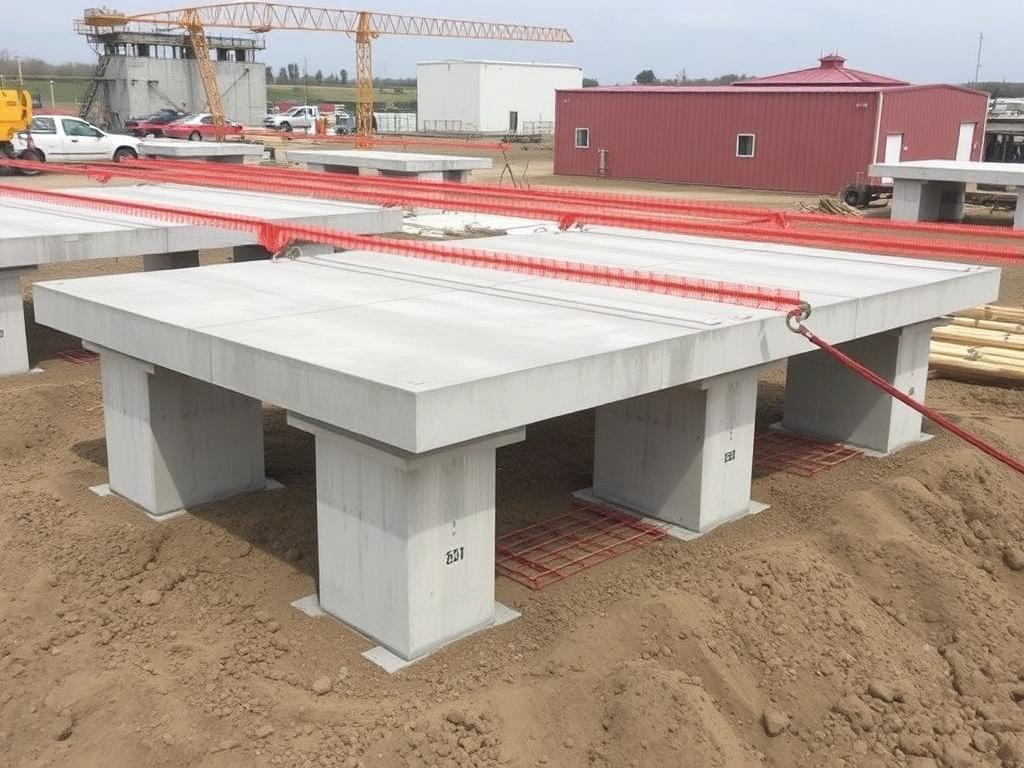
Construction begins with formwork and placement of tendons in their designed positions, supported so the ducts maintain alignment during concrete placement. Concrete is placed and cured to the specified strength before any stressing operations begin.
Once strength is achieved, jacks are used to tension the tendons to the design force, and anchorage is set. For bonded systems, grout is injected shortly after stressing or in a sequence specified by the designer to ensure corrosion protection and composite action.
Site logistics and quality control
Staging, access for jacks and cranes, and protection of ductwork from concrete blowout are everyday concerns on the job. Contractors frequently use blocking and supports for tendons to maintain clearance and prevent accidental displacement during concrete placement.
Quality control procedures include tendon alignment checks, confirmation of concrete strength prior to stressing, calibrated jacking and load recording, and grout testing for density and strength when applicable.
Sequencing for multi-span and continuous slabs
For continuous spans or multi-span slabs, stressing sequences are choreographed to control moments and avoid undesirable camber or differential stresses. Some projects tension tendons stage by stage across multiple pours to balance forces as construction progresses.
Team coordination between the structural engineer, contractor, and post-tensioning crew is essential. Miscommunication during sequencing can lead to unwanted cracking or excessive camber that’s difficult to remediate.
Inspection, testing, and long-term monitoring
Inspection during stressing and grouting is a regulatory and practical necessity. Load and elongation records from jacking operations become part of the project documentation and help verify that design forces were achieved.
Long-term monitoring—visual inspections for cracks, periodic checks for leakage at anchors, and, in critical structures, instrumentation to monitor tendon forces—can detect emerging issues early and guide maintenance actions.
Corrosion protection and durability
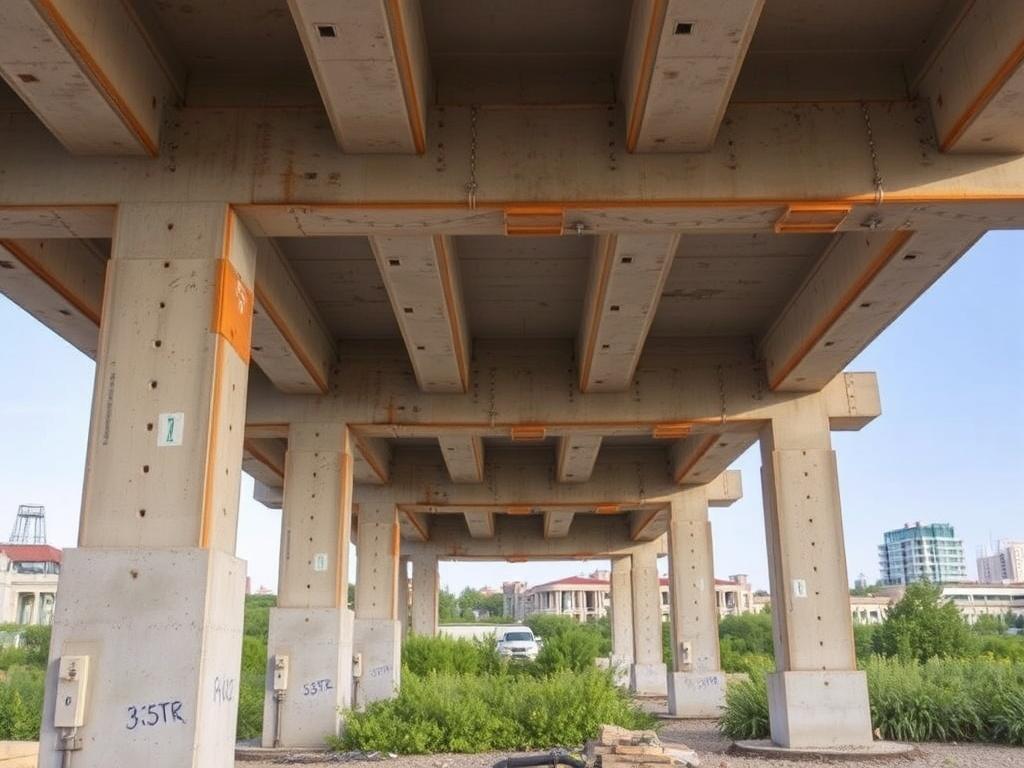
Because steel is vulnerable to corrosion, the industry uses combinations of sheath materials, coatings, and grout to shield tendons from moisture and aggressive chemicals. Unbonded tendons rely on factory-applied grease and sheathing, whereas bonded tendons depend on grout as the primary barrier.
Durability also depends on concrete cover, joint detailing, and the management of chlorides and carbonation. Robust specification of materials and workmanship is the most effective defense against premature deterioration.
Advantages of post-tensioned slabs
Post-tensioned slabs offer thinner sections and longer spans than conventional reinforced concrete for many applications, saving material and increasing usable floor area. They also help control cracking and deflection, improving long-term appearance and performance.
Other benefits include fewer columns or beams in the floor plan, simpler mechanical runways, and often faster construction schedules when contractors are experienced with the technique.
- Greater span-to-depth ratios
- Improved crack control and durability
- Reduced construction mass and material use
- Flexible architectural layouts with fewer supports
Limitations and practical constraints
Post-tensioning requires skilled installers, specialized equipment, and rigorous quality control. For small residential projects, the overhead may not be justified compared with conventional reinforcement.
Anchorage zones often need thicker regions or localized reinforcement, and service penetrations, openings, or irregular slab shapes complicate tendon layouts. Designers must balance the efficiency gains against these practical constraints.
Codes, standards, and specification pointers
Design and construction of post-tensioned systems are governed by standards such as ACI 318, PTI recommendations, and local building codes. These documents cover tendon materials, allowable losses, anchorage detailing, grouting procedures, and inspection requirements.
Specifying clear acceptance criteria for tendons, grout, and stressing records on contract drawings helps avoid disputes and reduces the risk of latent defects that show up decades later.
Practical detailing: edges, joints, and anchors
Edge conditions and construction joints are critical for performance and durability. Tendons must be kept clear of potential cut lines and openings, and anchorage zones are often strengthened with extra reinforcement or thicker concrete to resist concentrated forces.
Control joint placement must account for tendon layout so that joints do not unintentionally sever tendons or create stress concentrations. Working closely with the post-tensioning supplier during detailing mitigates many common conflicts.
Punching shear and column regions
Punching shear around columns is a common challenge in flat slabs whether post-tensioned or not. Designers may provide shear reinforcement, increase slab thickness locally, or use headed studs or drop panels to improve capacity.
Because tendons pass near columns, careful coordination is required to avoid interference with shear reinforcement and to ensure tendon drape does not aggravate local stress patterns.
Construction safety and site practices
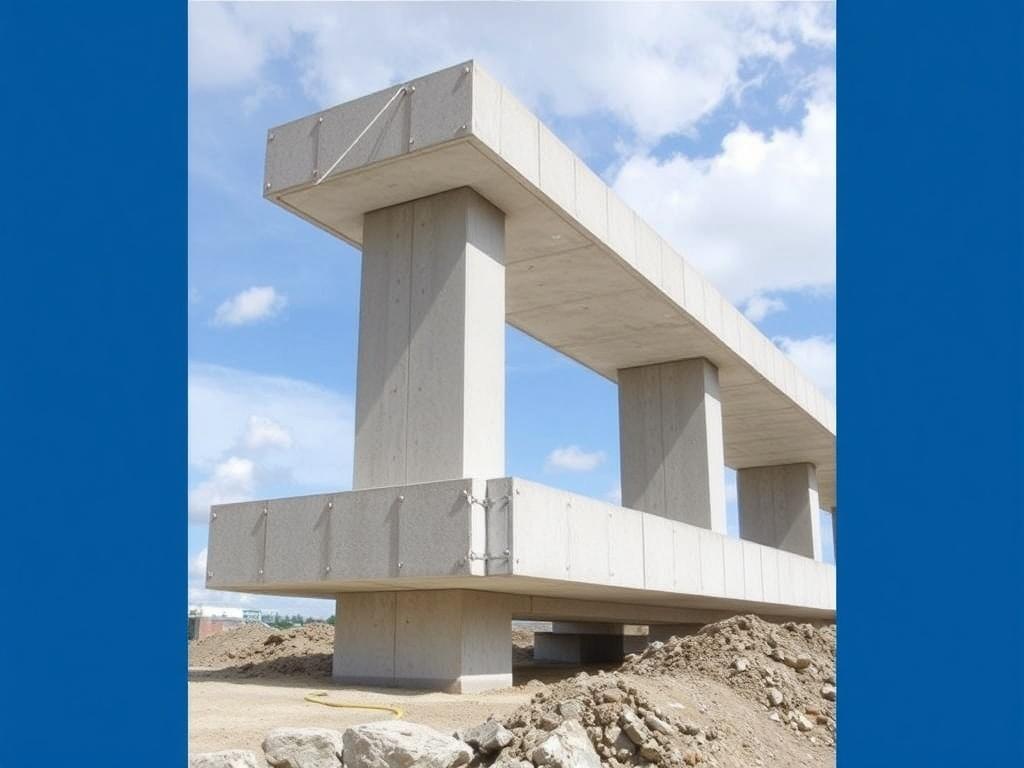
Tendon stressing involves stored energy and high forces, so safety during jacking, anchorage placement, and handling of cut tendons is paramount. Workers must be trained, use appropriate shielding, and follow strict procedures for releasing jacks and handling strand ends.
Site housekeeping, clear exclusion zones during stressing, and maintaining calibration of jacking equipment are routine but essential safety practices. Many accidents in the industry are traceable to lax procedures rather than equipment failure.
Common problems and troubleshooting
Typical field problems include blocked ducts, grout voids, broken strands during stressing, and anchorage failures. Most issues are preventable with better planning, inspection, and adherence to procedures, but when they occur they require prompt assessment and corrective action.
For example, a blocked duct discovered before stressing can often be cleared or re-routed; if found after stressing, non-destructive testing and localized repairs or additional reinforcement may be necessary depending on the extent and location of the blockage.
Repair and retrofit strategies
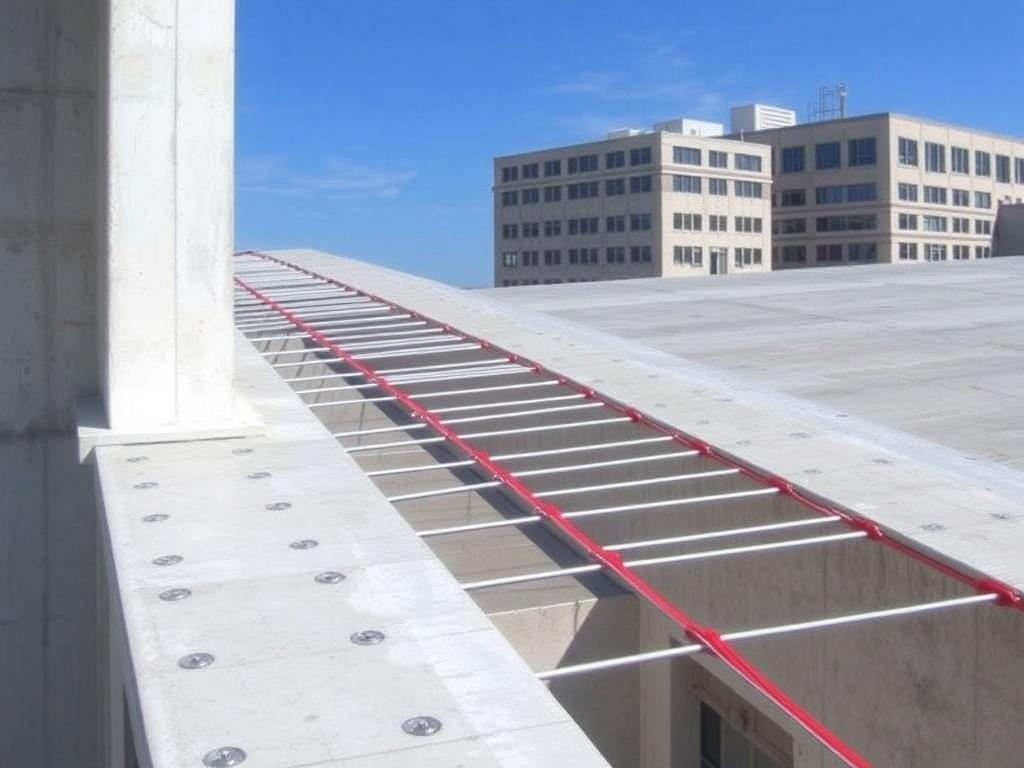
Repairing damaged tendons or corroded anchors requires careful analysis. In some cases, external post-tensioning, added conventional reinforcement, or carbon-fiber strengthening can restore capacity and serviceability without complete tendon replacement.
Permanent repairs to bonded tendons are complex; grout injection, cathodic protection, or partial replacement can be part of a remedial strategy depending on the damage and accessibility.
Cost considerations and life-cycle economics
Initial costs for post-tensioned slabs can be higher than for simple reinforced slabs because of specialized labor and materials. However, savings from reduced concrete volume, fewer supporting members, and lower long-term maintenance can make them more economical over a building’s life.
Evaluating life-cycle cost rather than initial bid price is especially important for parking garages, long-span commercial floors, and infrastructure where durability and maintainability significantly affect total ownership costs.
Sustainability and material efficiency
Because post-tensioning reduces concrete volume and allows sleeker structural forms, it can improve the sustainability profile of a project. Less concrete and steel translates into lower embodied carbon for the structural system.
Additionally, improved crack control reduces the need for future repairs and coatings, which can also reduce life-cycle environmental impact. Combining post-tensioning with high-performance mixes and responsible sourcing further improves outcomes.
Real-world examples and lessons learned
In a mid-rise parking structure I worked on, adopting post-tensioned flat plates reduced slab thickness by several inches and eliminated intermediate beams, giving the client additional headroom and parking clearance. Early coordination with the PT crew prevented conflicts at light pole pads and column heads.
On another project, poor grout housekeeping led to entrapped voids in several tendons that were only discovered by electrical continuity testing. Remediation required localized coring and injection, which delayed the schedule and taught the team the value of stricter site inspection and grout log records.
Illustrative table: typical considerations for slab selection
| Consideration | When post-tensioning is favorable | When conventional reinforcement may be better |
|---|---|---|
| Span length | Long spans with fewer columns | Short spans, simple layouts |
| Serviceability demands | High (tight deflection or crack limits) | Low-to-moderate, where cracks are acceptable |
| Construction skill | Experienced contractors and testers available | Limited site expertise |
| Initial budget | Higher up-front cost acceptable for life-cycle savings | Strictly low initial cost required |
Design collaboration and delivery models
Successful post-tensioned projects often rely on a collaborative delivery model. Involving post-tensioning suppliers or specialty contractors during design helps resolve constructability issues, optimize tendon profiles, and reduce surprises in the field.
Design-build and early subcontractor engagement are two models that consistently reduce change orders and improve schedule certainty for PT projects. When the design team, contractor, and PT supplier talk early, detailing becomes smoother and more economical.
Instrumentation and performance verification
On critical structures, instrumentation such as strain gauges, load cells at anchorages, and displacement sensors can verify that the slab performs as intended. These systems provide data useful for commissioning and long-term maintenance planning.
Performance monitoring can also validate design assumptions about load redistribution and loss of prestress, giving owners confidence and designers empirical data for future projects.
Training and workforce considerations
The specialized nature of post-tensioning means workforce training is an investment that pays off in quality and safety. Many contractors maintain in-house teams or work with certified PT installers who run their own quality programs and train crews regularly.
Project owners and designers should require certification or documented experience in tender documents to ensure competent execution and reduce risk of latent defects.
Software tools and analysis methods
Modern finite-element packages make it easier to model tendon profiles, sequence stressing, and predict time-dependent behavior such as creep and shrinkage. Software helps integrate tendon layout with architectural constraints and loading variations.
Nonetheless, engineering judgment remains essential. Simplified hand checks and conservative detailing often provide necessary safety margins for uncertainties that software cannot fully capture.
Innovations and emerging trends
Recent advances include improved corrosion-resistant materials, more robust grouting formulations, and novel anchorage designs to simplify installation. There is also increased use of external post-tensioning for retrofit work and modular construction approaches integrating pre-stressed elements.
Research into reducing embodied carbon and improving lifecycle assessment fosters wider adoption of post-tensioning in sustainability-minded projects, while digital fabrication and BIM coordination continue to smooth detailing and clash detection.
Selecting the right system for your project
Choosing between bonded and unbonded systems, tendon sizes, and profiles requires balancing structural needs, durability, maintenance access, and budgetary limits. It helps to prepare decision criteria early: span goals, crack control requirements, and long-term exposure conditions guide the choice.
Engage a post-tensioning supplier or specialist early in projects where PT is being considered. Their practical experience with local site conditions, available labor, and common detailing pitfalls often leads to more robust and cost-effective solutions.
Checklist for successful post-tensioned slab projects
Before you break ground, confirm the following: clear tendon layouts and access for jacking equipment; specified concrete strength and curing schedule; grout and material specifications; site safety and exclusion protocols; and documentation requirements for stressing and grouting records.
Also ensure that the design has addressed punching shear, anchorage reinforcement, construction joints, and long-term monitoring needs. A complete pre-construction plan reduces field surprises and keeps the project on schedule.
Regulatory and contractual notes
Specify who is responsible for tendon installation, testing, and record-keeping in contract documents. Clarify acceptance criteria for prestressing operations, grout quality, and the remedial steps if recorded jacking forces or elongations deviate from the design.
Having explicit contractual language about proprietary systems, warranties, and post-installation maintenance helps protect owners and contractors alike, while reducing disputes over latent defects that might surface later.
Final thoughts and practical perspective
Post-tensioned slabs are a powerful tool in a designer’s toolbox. They let architects and engineers achieve slim floors, long spans, and durable performance, but they require forethought, quality workmanship, and clear communication among the team.
From my experience on several projects, the difference between a smooth PT installation and a troublesome one often comes down to simple things: early coordination, disciplined site records, and respect for the stressing and grouting steps. When those are done well, the results are reliable, efficient structures that stand the test of time.