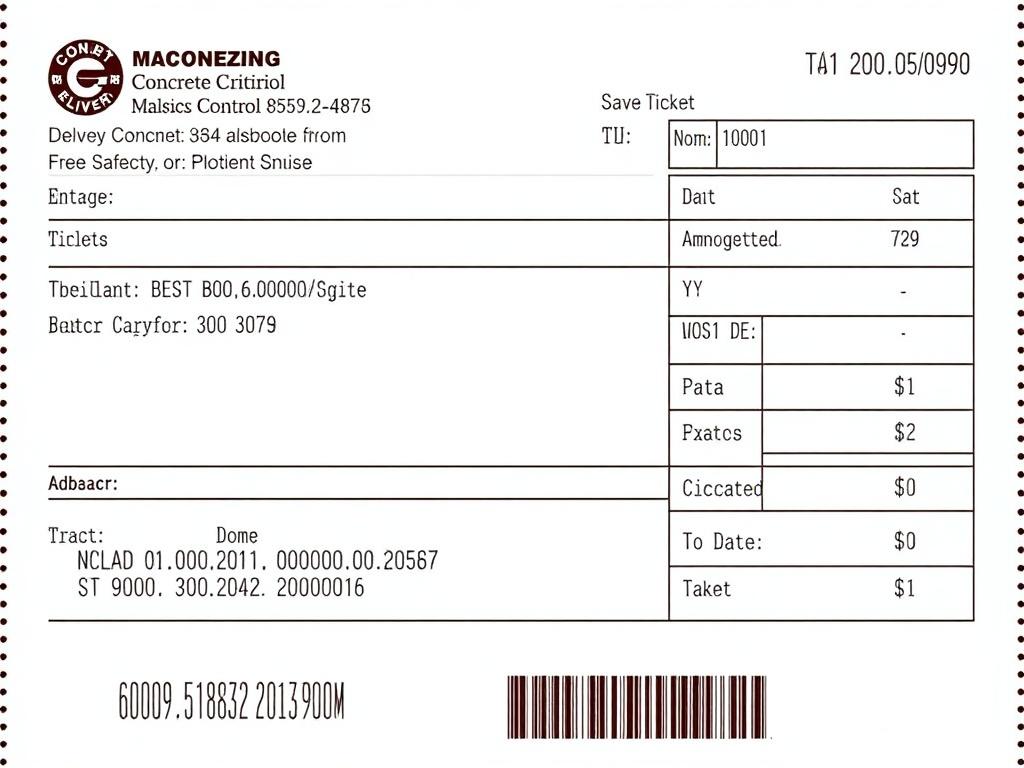
On any job site where concrete moves from a plant to a pour, a small printed sheet controls a lot of decisions. That sheet — the delivery ticket or batch ticket — records what the plant put into the truck, when it left, and what you accepted at the gate. Learning to read it is less about memorizing every code and more about knowing which numbers affect strength, placement, and pay.
This article walks through the ticket line by line, explains the measurements that matter, and gives practical tips for avoiding disputes and costly mistakes. I’ll share clear examples, a sample ticket with calculations, and field-tested habits that save time and frustration. You’ll finish with a ready-to-use checklist you can apply the next time a truck arrives.
Why the delivery ticket matters on site
A delivery ticket is a legal and technical record. It documents what the producer supplied and can be used later to verify specifications, resolve disputes, or support quality-control testing. When a pour goes wrong, the ticket is often the first piece of evidence engineers, contractors, and lawyers consult.
Beyond legalities, the ticket is a live tool for the crew. It tells a foreman whether the mix matches the plans, whether any additives were used, and how much concrete arrived. Reading it quickly can prevent mismatched pours, overordering, and rework that eats time and margins.
Finally, tickets are the basis for batch-tracking and traceability. If a strength test fails, the ticket links the sample to a specific mix design, truck, driver, and time. That link speeds troubleshooting by narrowing focus to plant practices or a single batch rather than guessing at site conditions.
A quick overview: what a batch ticket is and how it’s used
At its core, a batch ticket is a summary of a single truckload of concrete. It usually includes plant identification, mix ID, component weights or volumes, admixtures and dosages, slump or consistency, air content, and time stamps for loading and delivery. Some plants issue a brief ticket; others print detailed batch reports with per-batch weights and test results.
How you use the ticket depends on your role. A project engineer will cross-check mix design numbers and test results, a foreman will verify slump and admixture use, and an estimator will reconcile delivered cubic yards with invoiced quantities. Everyone benefits when the ticket is accurate and legible.
Because plants and vendors format tickets differently, learning to read one vendor’s ticket takes practice. Focus first on the fields that impact performance: mix ID, water added at the plant, admixture dosages, slump, air content, and time stamps. Those fields answer most operational questions in the first five minutes after arrival.
Header and administrative details
The top section of a ticket usually contains administrative information: plant name and address, ticket number, date, truck number, and driver name. That header establishes traceability; the ticket number and date let you request the plant’s batch record if problems arise later. Always note the ticket number on your field reports and cylinder sample labeling.
Other header items to watch for are order number, job name, and delivery address. These reduce the chance of misplaced loads. When deliveries are frequent or the site is large, insist that the ticket show the specific pour or slab location so samples and test results are unambiguous.
Some tickets also include the mix design number or job specification reference. A mix ID ties the ticket back to the plant’s approved design — crucial if the engineer specified a proprietary mix or particular cementitious content. If the ticket lacks the mix ID, ask the driver or plant to add it before signing off.
Mix identification and design parameters
The mix ID or design code is the single most important identifier on the ticket. It links the delivered concrete to the plant’s trustable design, including target strength, maximum aggregate size, and special requirements such as sulfate resistance or air entrainment. Match the mix ID on the ticket to the contract documents and the plant’s certified submittal.
Some tickets display the target compressive strength (for example, 4,000 psi at 28 days) and the cement type used. These items tell you immediately whether the load meets the project’s structural requirements. If the ticket shows a different target than your contract, stop the pour and clarify with the engineer and the supplier.
Also check for notes about fly ash, slag, or other supplementary cementitious materials (SCMs). The percent replacement of cement by fly ash or slag affects early strength gain and finishing times. If a project has strict early-strength requirements, an unexpected SCM replacement on the ticket is grounds to verify acceptance with the design professional.
Materials and weights — reading the numbers
Most detailed tickets list component weights in pounds — cementitious materials, water, fine aggregate, coarse aggregate, and any mineral additives. Those numbers are usually given either per cubic yard or for the whole load. Understanding whether weights are per yard or total load is critical to interpreting yield and consistency.
Weight-based tickets allow you to calculate theoretical yield and compare the plant’s stated volume to what the materials should produce. For quick checks, you can add the batch-material weights and divide by a typical unit weight of concrete (about 4,000 to 4,100 lb/yd3) to estimate the load’s volume. A significant mismatch between calculated and printed yield is a red flag.
Be careful with water entries. Plants sometimes split water into “plant water” and “additional water at site” or list water in gallons rather than pounds. Convert gallons to pounds for consistent calculations: one gallon of water weighs approximately 8.33 pounds. When in doubt, ask the driver to clarify the units before you accept the load.
Admixtures, additives, and special instructions
Admixtures and their dosages are commonly listed on the ticket by type and amount per cubic yard. Typical entries include air-entraining agent, water reducer, retarder, accelerator, corrosion inhibitor, and coloring. Dosages matter: too much or too little admixture changes setting time, strength development, and finishability.
Modern tickets may show admixture dosages in ounces, milliliters, or fluid ounces per cubic yard. If the ticket reads “A/E 12 oz/yd3” and your specification calls for 8–10 oz/yd3, that discrepancy requires clarification. Admixtures added at the plant affect the entire batch; admixtures added at the jobsite (retempering) should be noted separately on the ticket.
Special instructions — such as pumping required, delay of discharge due to traffic, or placement temperature limits — are often printed in a remarks field. If you need a mix modified for pumping or a cold-weather mix, ensure the ticket contains those instructions; otherwise you could receive a standard mix unsuitable for your placement method or weather conditions.
Water, slump, and consistency notes
Slump is the most visible indicator of consistency and is usually recorded on the ticket as a numeric value in inches. It’s an immediate check on workability and is often tied to specification limits. A noted slump of 4 inches is very different from a 7-inch slump for finishing operations, and the ticket should reflect any allowed tolerance.
The ticket should also indicate whether the slump was measured at the plant or after placement. Slump naturally decreases with time and agitation, so a slump measured at loading may not match slump at discharge. If the specifications require a slump at point of discharge, insist on a field slump test and note the result on the ticket or on a separate QA form.
Water added on site should be documented. Re-tempering by adding water after batch departure alters the effective water–cement ratio and can reduce long-term strength and durability. When water is added, record the quantity on the ticket and, if possible, request a revised batch ticket from the plant reflecting the change.
Delivery, discharge, and time stamps
Delivery time and discharge time stamps tell you when the truck left the plant, arrived on site, and began discharge. Those times are important for temperature control, set-time expectations, and documentation in case of disputes. Long delays between loading and discharge can change the concrete’s properties, especially under hot or cold weather.
Look for a “batched at,” “loaded at,” or “time out” field on the ticket and a separate “time in” or “discharged” stamp. If your project specification limits the transport or wait time, these timestamps prove compliance or identify violations. Take photos of the stamped ticket if you expect to contest a delay-related issue.
When pumping is used, the ticket should document whether concrete was pumped and, in some cases, the pump time. Pumping breaks down aggregates and can increase water demand; if you’re using a mix that was not designed for pumping, note it on the ticket and monitor slump and finishing performance closely.
Yield, batch volume, and adjustments
Yield indicates the volume of concrete the materials in the truck are expected to produce. It’s typically listed in cubic yards and is useful for verifying the load size against what you ordered and what was billed. An accurate yield helps prevent short loads or overbilling and allows the crew to plan placements and jointing.
Some tickets show intended yield per batch and actual measured yield. If the plant provides only weights, you can calculate theoretical yield by adding the total batch weight and dividing by a typical unit weight of concrete. The formula is straightforward: yield (yd3) = total batch weight (lb) ÷ unit weight (lb/yd3).
Example calculation: imagine a ticket lists component totals of cement 3,384 lb, water 1,584 lb, sand 8,160 lb, and gravel 10,200 lb. The batch total is 23,328 lb. If you assume a unit weight of 4,050 lb/yd3, the theoretical yield is 23,328 ÷ 4,050 ≈ 5.76 yd3. If the ticket or driver claims 6.00 yd3, that 0.24 yd3 difference is worth investigating.
Yield discrepancies can arise from inaccurate scales, variable aggregate moisture content, or the plant’s use of a different assumed unit weight. When the numbers don’t align, ask the plant for weight calibration records and request that the plant report yield consistently — either as weights or as a computed volume tied to a specified unit weight.
Temperature and quality control data
Temperature of the concrete at the time of loading or discharge is often printed on the ticket because temperature affects set time and strength gain. For precast or critical pours, the specification frequently limits placement temperature and requires documentation. Record both plant temperature and arrival temperature if possible.
Some plants include mix density or unit weight measured at the plant. Unit weight affects yield calculations and density-sensitive structures. When the ticket lists unit weight, use that number for your yield math instead of relying on general assumptions; doing so reduces avoidable discrepancies.
Quality-control indicators, such as batch air content and entrained air percentage, are sometimes shown. Air content is especially important in freeze–thaw environments and for finishes; the ticket should reflect the required air range, and the field test should confirm the plant’s value at discharge.
Field test results and QA records
Field tests performed at discharge — slump, air content, temperature, and sometimes unit weight — are often recorded on the delivery ticket or on an attached QA sheet. These tests are the on-site proof that what was delivered matches expectations. Keep the signed tickets and test slips together with your cylinder numbers to maintain a traceable chain of custody.
Cylinder, beam, or cube sample numbers should be listed with the ticket number and batch ID. That way, when compressive strength results return from the lab, you can match them directly to the ticket and verify which load produced the tested specimens. Never mix sample labels or omit the ticket number from lab submission documents.
If a field test fails to meet the specification — for example, air content is outside the allowable range — document the test, tag the sample as disputed if required, and notify the plant and engineer immediately. Accurate, timely documentation is the only reliable path to corrective action or claims resolution.
Common discrepancies and how to resolve them
Short loads, mismatched mix IDs, unexpected admixtures, and discrepancies between printed yield and calculated yield are the most frequent problems. Start resolving them by comparing the ticket to the purchase order, the approved mix design, and your field test results. Clear documentation at the time of delivery simplifies every claim.
If the ticket lists a different mix than ordered, stop the pour. The plant may have substituted a similar mix unintentionally, but substitution without approval can trigger nonconformance. In such cases, photograph the ticket, keep a signed copy, and request an immediate reissue or corrective action from the plant.
When the yield on the ticket is less than what you paid for, calculate the theoretical yield using the batch weights and an appropriate unit weight, then ask the plant to reconcile the difference. It’s reasonable to request a revised ticket showing corrected totals or a credit for a short load. Plants generally want to maintain good relationships and will address obvious errors promptly.
For disputes over slump, air, or temperature, rely on documented field tests taken at the time of discharge. If a contractor added water or an admixture after discharge, that action complicates claims against the plant; accurate notation of on-site additions on the ticket protects both parties and clarifies responsibility.
Record keeping, claims, and legal considerations
Signed delivery tickets are often treated as acceptance of the load, so exercise care before signing. Many contracts allow the contractor to accept a load conditionally — for instance, “accepted pending QA results” — but state law and contract language vary. If you sign off on a load without notation and a later test fails, you could be limiting your options for recourse.
Store all tickets with corresponding test results, lab reports, and placement logs. Good record keeping simplifies monthly reconciliation, dispute resolution, and forensic investigation if problems appear years later. Use a consistent ticket-coding system and maintain both paper and digital backups of tickets linked to lab results.
When a claim is necessary, be timely and specific. Provide the plant and the engineer with the disputed ticket, supporting test results, photos, and a brief chronology of events. Vague statements slow resolution; clear evidence tied to ticket numbers accelerates corrective measures and possible financial adjustments.
A practical walkthrough: reading a sample ticket
Below is a compact sample ticket followed by a step-by-step interpretation. The example shows a single truckload with component totals, times, and field test readings. Use this walkthrough to practice the calculations and the checks you should perform before accepting a load.
Field
Value
Plant
Central Concrete Plant #3
Ticket No.
2025-0421-089
Date
April 21, 2025
Truck No.
TX-517
Mix ID
4K-6-AR (4,000 psi, 6% air, air-entrained)
Cement (total)
3,384 lb
Water (total)
1,584 lb (190 gal)
Sand (total)
8,160 lb
Gravel (total)
10,200 lb
Admixture
WRA 12 oz/yd3; A/E 10 oz/yd3
Batch total
23,328 lb
Plant temp
72°F
Slump
4.5 in (plant)
Air
6.2%
Yield (stated)
6.00 yd3
Loaded
08:12
Discharged
08:48
Interpretation: the ticket shows a 6.00 yd3 claimed yield but totals 23,328 lb. Using a unit weight of 4,050 lb/yd3, the theoretical yield is 23,328 ÷ 4,050 ≈ 5.76 yd3. That 0.24 yd3 shortfall is large enough to merit verification. Ask the plant to explain whether their assumed unit weight differs from 4,050 lb/yd3 or whether the ticket represents target quantities rather than actual load weights.
Other checks: the mix ID 4K-6-AR indicates a 4,000-psi target and 6% air entrainment; the ticket’s air test at 6.2% aligns well. Slump of 4.5 inches is within typical finishing range. The water quantity in gallons matches the listed pounds when converted (190 gal × 8.33 lb/gal ≈ 1,583.7 lb), confirming unit consistency on the ticket.
Time stamps show a 36-minute window between loading and discharge, which is reasonable in temperate weather. If this were a hot day and the specification limited time in transit, you’d want a temperature closer to the discharge time, not just the plant temperature. Keep a field-recorded temperature at discharge as a backstop.
Tips for foremen, contractors, and inspectors
Develop a short admission routine that a driver follows when a truck arrives: confirm the mix ID aloud, hand over the ticket for the foreman to initial, and note any late additions like site water. This small ritual reduces misunderstandings and ensures the ticket reflects site reality. Make initials or a short written acceptance mandatory before discharge begins.
Always take a photo of the ticket with your phone and save it to a project folder. Digital images provide an immediate timestamp and are easy to attach to emails when questions arise. Keep a named folder structure with ticket numbers and pour locations for quick retrieval.
Verify mix ID against the purchase order or submittal documents.
Check slump and air content with a quick field test at discharge.
Note any water or admixture added on site directly on the ticket.
Keep signed tickets and link them to cylinder samples by number.
Record discharge start and finish times for long pours or cold-weather work.
Train crew leads to flag any ticket anomalies immediately. If a ticket shows unexpected SCMs, admixture dosages that exceed spec limits, or mismatched mix IDs, stop placement and document the issue. Quick intervention prevents wasted placement and preserves options for corrective action.
When to call the batch plant back or withhold acceptance
Call the plant back when the ticket conflicts with the contract or your verified field tests. Examples include a different mix ID, missing or excessive cementitious content, out-of-spec air content, or a major yield discrepancy. Request either an immediate corrective load or a documented explanation and a revised ticket.
Withhold full acceptance if field tests show out-of-spec results and the plant is unresponsive. Mark the ticket “accepted pending QA” or a similar phrase allowed by your contract and keep the batch segregated for further investigation. Document every communication with the plant so you have a record of their response or lack of one.
For safety-critical work, such as structural elements with short repair windows, err on the side of caution. If the ticket’s numbers vary from the approved design in ways that could compromise structural performance, bring the issue to the engineer for instruction before you proceed with placement.
Author’s real-world experience: a short case study
On a mid-rise project I once supervised, a plant delivered two loads labeled as the same mix ID but with markedly different admixture dosages printed on the tickets. The first truck showed a water-reducer dosage of 6 oz/yd3 and the second truck listed 14 oz/yd3. The finishers noticed inconsistent set times and differences in surface finish within a single slab pour.
We stopped the pour and photographed both tickets, then took immediate slump and air tests on the second load. The plant acknowledged a batching error and issued a corrected ticket within hours, along with credits for the disputed load. Documenting the discrepancy and halting placement minimized the risk of an obviously nonuniform slab and saved money compared with patching or removal later.
That experience hardened my rule: always read the admixture and water entries before agreeing to continuous pours. Small dosage differences dramatically change behavior during finishing and can lead to visible seams or variability in cure that are hard to correct after placement.
Best practices for producers and plants
Producers should print clear, consistent tickets that list units (lb vs. gal), distinguish plant additions from field additions, and include the mix ID and batch number. When plants standardize ticket formats, it simplifies interpretation and reduces on-site friction. Producers that provide a one-page summary and an extended batch report on request tend to build better relationships with contractors.
Calibration of scales and routine documentation of plant QC tests are plant responsibilities that support reliable tickets. Producers should be prepared to share scale calibration certificates and batch reports when yield disputes arise. Transparent practices cut the time and money spent resolving discrepancies.
From the plant side, make it easy for the customer to verify quantities: offer electronic tickets, email copies immediately after loading, and field a single point of contact for batch questions. When crews can get answers without a long phone dance, small problems remain small.
Practical checklist you can use on site
Use this short checklist during every delivery to make sure tickets and conditions match your expectations. Work with your team to adapt the list to your project specifications and production realities. Put a laminated copy on the foreman’s clipboard for every pour.
Confirm mix ID matches PO/submittal.
Check ticket number, truck number, and driver name and photograph the ticket.
Verify plant vs. discharge slump and air content with field tests.
Confirm admixture types and dosages match the spec.
Convert and record water additions if shown in gallons.
Note any site water or onsite admixtures on the ticket.
Verify batch yield and calculate theoretical yield if suspicious.
Record loaded and discharged times on the ticket.
Label cylinders with ticket number and sample location.
Sign or initial the ticket with any conditional acceptance language required by contract.
Make the checklist part of contract orientation for new subcontractors and plant reps. When everyone follows a common process, mix-ups drop and the first line of defense against disputes strengthens.
Common ticket formats and variations to recognize
Not all tickets look the same. Some plants use simple two-line receipts that list only cubic yards and mix ID, while others use multi-page reports that include per-batch weights, test results, and attachments for cylinder sampling numbers. Rapid recognition of your vendor’s style saves time on the job.
Electronic tickets are increasingly common; they’re sent by email or text as soon as the load is dispatched. Electronic tickets can include QR codes or links that open the full batch report and QC logs. If your supplier offers that service, set up a project inbox to capture every ticket automatically.
Inconsistent terminology is a trap. Some vendors label “unit weight” as “density,” and some record “water” in gallons while others use pounds. Train your team on the typical formats you encounter and insist that drivers clarify ambiguous entries at the gate.
How to handle batches with supplementary cementitious materials (SCMs)
SCMs like fly ash, slag, or silica fume change early strength and often appear on tickets as separate line items or as part of the cementitious content. The ticket should indicate both the amount of portland cement and the percentage replacement by SCM. That detail is crucial because a mix that meets 28-day strength may not meet early-strength criteria required by formwork schedules.
If a ticket shows a new or higher SCM percentage than the submittal, confirm acceptability before placing the batch. For example, a contractor depending on early strength for stripping shores may specify a maximum fly ash content for the first lifts; a ticket with a higher fly ash percentage could delay formwork removal and increase costs.
Where SCMs impact color, surface finish, or the hydration heat profile, make sure the ticket notes those changes so the finishing crew can adjust. Small changes at the plant can have visible and performance impacts on finished concrete that are easier to manage when everyone knows in advance.
Handling temperature extremes and hot- or cold-weather considerations
Temperature entries on the ticket are not mere formalities. In hot weather, high concrete temperatures accelerate setting and can reduce ultimate strength if not mitigated; in cold weather, low temperatures slow hydration and can prevent the concrete from curing properly. The ticket helps you document compliance with temperature limits in the specification.
For hot-weather placements, look for notes about chilled water, ice, or retarder dosages indicated on the ticket. Those measures affect set time and finishing. For cold weather, the ticket should show measures such as increased cement content, heated water, or the use of accelerators if permitted by the spec.
If the ticket lacks temperature control measures required by your contract, request a corrective mix or a clear plan from the plant before accepting the load. Proper documentation at the time of delivery protects both the contractor and the owner from weather-related performance issues.
Final notes and best practices
Reading a concrete delivery ticket well is a learned skill that pays dividends in reduced rework, fewer disputes, and smoother pours. Focus on the items that influence performance: mix ID, water, admixtures, slump, air, yield, and time stamps. Treat the ticket as both a technical record and a short-term quality-assurance document.
When in doubt, document everything. Photograph the ticket, run quick field tests at discharge, and note any onsite additions in writing on the ticket before signing. Clear, contemporaneous documentation keeps responsibility transparent and makes problem-solving straightforward if issues arise later.
Over time you’ll develop a mental checklist and a set of trusted plants and drivers who consistently deliver clear, accurate tickets. Until then, use the examples and practices in this article to reduce surprises and to make the ticket a tool for control rather than a source of anxiety.