Concrete is deceptively simple: cement, water, and aggregates. Yet the balance among those ingredients—especially water and cement—determines whether a slab will crack, a column will support its load, or a repair will last decades.
This article walks through the chemistry, the field realities, and practical calculations you can use to pick a target water-to-cement ratio and to adjust that target on the job. I’ll mix clear principles with real-world examples from projects I’ve overseen so you can move beyond rules of thumb toward reliable results.
Why the water-to-cement ratio matters
Water is the activator: it hydrates cement and creates the paste that binds aggregate particles. Too little water and the mix won’t hydrate fully or will be unworkable; too much water weakens the hardened concrete by creating excess capillary porosity.
The water-to-cement ratio (w/c) is the mass of mixing water divided by the mass of cement in the mix. That single number strongly correlates with long-term strength, permeability, and durability, and it’s often the most useful control parameter available to designers and field teams.
Basic trade-offs: strength versus workability
Lowering the w/c increases potential compressive strength and reduces permeability, but it also reduces slump and makes concrete harder to place and consolidate. Conversely, adding water improves workability but creates more voids after evaporation, weakening the concrete.
A well-designed mix hits a balance: a low enough w/c for intended strength and durability, but with enough flowability (or the right admixtures) to ensure thorough consolidation and good bond with reinforcement.
Abram’s principle and what it really means
Engineers often invoke Abram’s law: strength is roughly inversely related to the water-to-cement ratio. That’s not a mystical rule; it’s an empirical observation from many tests showing lower w/c tends to yield higher strength if other things are equal.
However, Abram’s principle assumes good compaction and curing. You can’t achieve higher strength simply by reducing water if the mix becomes so stiff that it traps voids or prevents proper consolidation around reinforcement.
Chemistry of hydration and porosity
When cement hydrates, chemical reactions consume water and form solid products that bind aggregates. Complete hydration of all cement particles requires a finite amount of water—typically more than the minimum needed to create a workable paste.
Excess water that is not consumed by hydration forms capillary pores as it leaves the hardened paste. These pores reduce strength and increase permeability, which makes the concrete more vulnerable to freeze-thaw cycles, chloride ingress, and chemical attack.
Why some water is “lost” to aggregates
Aggregates are not perfectly dry. Some water is absorbed into aggregate pores or clings to particle surfaces as free moisture. This water is not available for cement hydration unless it desorbs into the paste during mixing and placement.
Ignoring aggregate moisture leads to an effective w/c that is higher than calculated. For consistent results, measure aggregate moisture content and account for it in your batch water calculation.
Curing’s impact on hydration
Hydration continues as long as moisture and reasonable temperature are present. Good curing—keeping the surface moist for the early days—allows more of the cement to hydrate and minimizes shrinkage-related cracking.
Shortchanged curing can negate the advantage of a low w/c: even with a small w/c, poorly cured concrete won’t reach expected strengths because hydration is interrupted and microcracks form at the surface.
Typical water-to-cement ratios and what they imply
Practical mixes tend to cluster in a few ranges. High-strength structural concrete often targets w/c between 0.30 and 0.40, standard structural mixes commonly fall in the 0.40–0.50 range, and non-structural or mass concrete may be 0.50–0.60 or higher.
These bands are rough. The same w/c can give different strengths depending on cement type, aggregate gradation, admixtures, mixing method, and curing conditions. Use ranges as a starting point, not an absolute prediction.
Typical w/c range
Common use
General strength implication
0.30–0.40
High-performance and high-strength concrete
High strength and low permeability
0.40–0.50
Most structural concrete
Good balance of strength and workability
0.50–0.60+
Light-duty, plain concrete, some mass pours
Lower strength and higher permeability
How to calculate mixing water from a target w/c
The calculation is straightforward in principle: water mass = w/c target × cement mass. If you know how much cement you’ll use in a batch or per bag, multiply by the target ratio to get the water mass in kilograms (or pounds).
Remember that 1 kilogram of water equals 1 liter, and 1 gallon of water weighs about 8.34 pounds. Use consistent units when you compute and when you check batch tickets on ready-mix deliveries.
Example: single-bag calculation
For a typical 94 lb (42.6 kg) bag of portland cement and a target w/c of 0.45: water mass = 0.45 × 42.6 kg ≈ 19.2 kg, which is roughly 19.2 liters. In US customary units, 94 lb × 0.45 ≈ 42.3 lb of water, or about 5.07 gallons.
This simple example illustrates why many field crews say “a 94-lb bag and 5 gallons”—that’s the w/c-driven arithmetic behind a common rule of thumb. But you must adjust this number for any moisture already present in the aggregates.
Example: batch-scale calculation
Suppose a mix design uses 300 kg of cement per cubic meter and targets w/c = 0.50. The required mixing water per cubic meter is 0.50 × 300 = 150 kg, which is 150 liters of water per cubic meter of concrete.
That water volume includes water absorbed by aggregates unless you explicitly subtract aggregate moisture. In practice you’ll measure aggregate moisture in the field and reduce batch water accordingly to meet the target effective w/c.
Adjusting for aggregate moisture and water absorption
Aggregates are rarely bone dry. The two important terms are moisture content (free water on the surface and within pores that is exchangeable) and absorption (water held within the aggregate that may release slowly or stay trapped).
To get the effective mixing water, subtract the water contributed by aggregates from the calculated batch water. The formula is: batch water = target water — water in aggregates + adjustment for admixtures or temperature, where “water in aggregates” is computed from their mass and measured moisture percentage.
Practical field example
Imagine you’re batching a small job with 200 kg of sand and 400 kg of coarse aggregate, and lab tests show sand moisture 3% and coarse aggregate moisture 1%. The water contributed by aggregates equals (200×0.03)+(400×0.01)=6+4=10 kg.
If your target water for the cement quantity is 120 kg, deduct the 10 kg aggregate water and set batch water to 110 kg. Failing to do this would raise the effective w/c and reduce expected strength.
Measuring aggregate moisture reliably
For accurate adjustments, weigh samples before and after oven-drying to determine moisture content, or use moisture probes for quick spot checks. Frequent checks are essential when aggregates come from stockpiles that change with weather.
Keep records and communicate adjustments to batching control so the same w/c is maintained across shifts and trucks. Small variations in aggregate moisture can accumulate to meaningful changes in effective w/c over large pours.
Admixtures and supplementary cementitious materials (SCMs)
Admixtures such as water reducers and superplasticizers let you lower the water content while maintaining workability. This means you can achieve a lower effective w/c without sacrificing slump during placement.
Supplementary cementitious materials—fly ash, slag, silica fume—also change the relationship between w/c and strength. Some SCMs allow lower w/c for the same strength, while others affect early strength development.
Using superplasticizers
Superplasticizers are powerful tools: they can cut mixing water by 10–30% for a given workability. That translates directly into higher potential strength and lower permeability, provided they are used according to manufacturer guidance.
Watch out for overdosing and timing issues; superplasticizer effectiveness is sensitive to mix composition and batching procedure. Trial mixes are essential to determine the correct dosage for your cement and aggregates.
SCMs and their effect on w/c and strength
Fly ash and slag often reduce heat of hydration and improve long-term strength and durability, especially with a lower w/c. Silica fume dramatically refines pore structure but typically demands higher cementitious content and careful dispersion.
Because SCMs change how cementitious materials react with water, you cannot simply apply the same w/c-target logic without re-evaluating strength gains through trial specimens cured under job conditions.
Designing a mix to meet a target strength
Concrete mix design typically begins with a required compressive strength and then selects a target w/c based on experience, laboratory data, and code recommendations. From target w/c you calculate water mass and then choose cement content that provides workability and paste volume.
Cement content cannot be arbitrarily low if you want a particular strength at a given w/c; lower cement mass at fixed w/c simply means less paste volume and reduced ability to coat aggregates and provide a dense matrix.
Rule-of-thumb approach
A common approach is to choose a target w/c compatible with required durability and strength (say 0.45) and then select cement content to provide adequate paste and workability (perhaps 300–350 kg/m3). From there, compute mixing water and aggregate proportions.
That approach gets you in the ballpark, but final proportions should be verified with trial batches cured and tested to the specification schedule, typically 7- and 28-day compressive strength tests.
Worked example: deriving a batch
Suppose the project calls for 4,000 psi (≈28 MPa) concrete and the design team recommends w/c = 0.45. If you pick 300 kg cement per cubic meter, water = 0.45 × 300 = 135 kg. Then choose aggregate volumes and admixtures to achieve the desired slump.
Adjust aggregate grading so paste requirements are not excessive. After mixing trial batches, test cylinders and iterate cement content or admixture dosage until the lab shows the targeted 28-day strength with acceptable workability.
Laboratory trials and field validation
Never rely on calculation alone. Lab trial mixes and cylinder tests under representative mixing, placing, and curing conditions are the definitive proof that your target w/c and proportions will deliver the specified strength.
Create trial batches that replicate field procedures: same mixer type, same mixing sequence, same ambient conditions if possible. Cure specimens the way you plan to treat the structure—on-site curing differences can significantly alter results.
Testing schedule and interpretation
Cylinders are commonly tested at 7 and 28 days to gauge early and nominal strength. If strength at 28 days meets the specification, the mix and the effective w/c are acceptable for the intended use.
If the 28-day strength falls short, analyze causes: was the effective w/c higher than targeted due to aggregate moisture, was curing inadequate, or was the cement batch weak? Don’t reflexively add cement or reduce w/c until you know the root cause.
Field issues: slump, consolidation, and finishing
Slump is a practical indicator of workability, but it doesn’t directly measure w/c. Two mixes with the same slump can have very different w/c values when one uses a water reducer or a different aggregate grading.
Ensure that low w/c mixes are compatible with placing and consolidation methods. Poor consolidation traps air and creates honeycombing, which undermines the benefit of low w/c by introducing structural defects.
Finishing and surface quality
Overworking a stiff mix during finishing can induce segregation or draw excess water to the surface, causing laitance and weakening the surface layer. Conversely, trying to make an under-watered mix easy to finish by adding surface water creates a weaker near-surface zone.
Finish with appropriate techniques—use power screeds for slabs, vibration for confined elements, and avoid adding water at the surface. If workability is insufficient, correct it with approved admixtures or by adjusting proportions in subsequent batches.
Common mistakes and how to avoid them
Typical errors include failing to account for aggregate moisture, assuming slump equals w/c, and attempting to reduce w/c without compensating for placement and curing difficulties. Each mistake has predictable consequences on strength and durability.
Good practice is proactive: measure and document aggregate moisture daily, perform trial mixes when materials or suppliers change, and maintain a simple log linking batch tickets to test results so trends are visible early.
Don’t chase early strength with more water
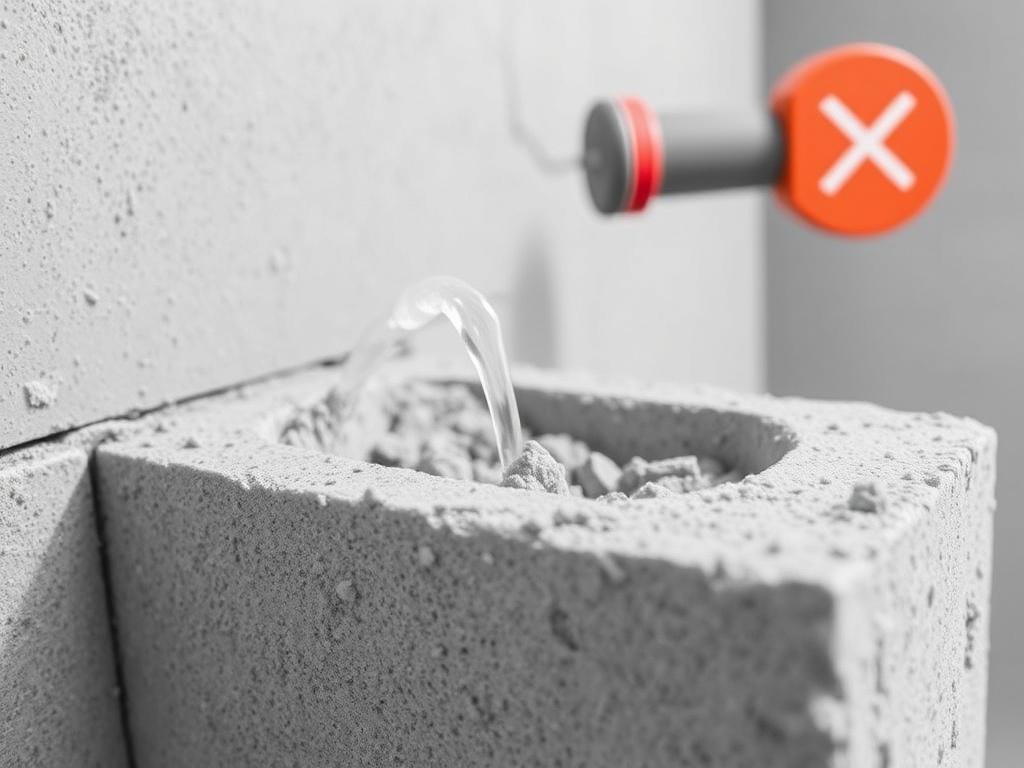
Adding water to boost workability or to compensate for poor finishing can increase early strength in the short term due to better consolidation, but the net long-term effect is often a weaker and more permeable structure. Use additives instead of water when possible.
For small adjustments, a moderate dose of water-reducing admixture is more responsible than adding water; for larger issues, redesign the mix or vary cement content and aggregate grading rather than diluting the paste.
Case study: a renovation poured under hot conditions
On a summer slab replacement I supervised, the aggregate stockpiles were sun-baked and hot; the sand surface had a moisture content markedly lower than the lab baseline. The first truckloads produced lower slump than expected and the crew added water at the mixer to maintain placement speed.
That practice caused a noticeable drop in compressive strength on the 28-day tests. Once we measured aggregate moisture on-site and adjusted batch water downward while adding a mid-range water reducer, the later batches produced consistent slump and higher strength.
Lessons learned
Measure, don’t guess. Environmental factors—temperature, wind, sun—affect evaporation and demand more precise control of batch water. Admixtures are valuable when used intentionally and tested in trial mixes.
Proceeding from lab design to field execution with continuous verification saved that project from costly rework and demonstrated the value of integrating moisture measurement, admixture use, and batch documentation.
Practical checklist for achieving your target w/c
Decide target w/c based on durability and strength requirements.
Calculate mixing water from cement mass then adjust for aggregate moisture and accepted admixture water contributions.
Run trial mixes that replicate field handling and curing, and test specimens to 28 days.
Use water reducers or superplasticizers to improve workability without raising w/c.
Monitor and record aggregate moisture daily and adjust batch water accordingly.
Ensure adequate curing; a low w/c is less effective without proper moisture retention during the early ages.
Formulas and quick references
Here are the practical calculations you’ll use most often: water mass = target w/c × cement mass. Adjusted batch water = water mass − (aggregate mass × moisture fraction) + admixture water adjustments.
For converting between units, remember: 1 kg water = 1 liter; 1 gallon water ≈ 8.34 lb. Keep units consistent and double-check the batch tickets from ready-mix suppliers to confirm they reflect the intended water content.
Sample calculation with numbers
Concrete mix: cement = 300 kg, target w/c = 0.45. Calculated water = 300 × 0.45 = 135 kg (liters). Aggregate moisture: sand 2% at 600 kg = 12 kg water; coarse aggregate 1% at 1100 kg = 11 kg water. Effective batch water = 135 − (12+11) = 112 kg.
If a superplasticizer contributes 1 kg of liquid per cubic meter in the admixture solution, you can subtract that 1 kg from batched water if the manufacturer indicates that volume counts toward mixing water. Always confirm with the product data sheet.
Quality assurance and documentation
Keep a simple but consistent documentation workflow: record cement batch and supplier, aggregate source and moisture tests, admixture type and dosage, target and actual batch water, slump, and test results. This traceability pays off when investigating strength anomalies.
When problems arise, the records typically point to the likely cause—an increase in aggregate moisture, a new cement source with different fineness, or a change in admixture—allowing corrective action without guesswork.
Working with ready-mix suppliers
If you rely on ready-mix concrete, provide the supplier with the target w/c and any constraints on admixture use. Ask for a mix design, and request that batch tickets show both the added water and any water included in liquid admixtures.
Perform independent verification: take a left-over sample from a delivered truck, measure slump, unit weight, and if necessary, cast a cylinder to verify that actual delivered material meets the specifications and your target effective w/c.
When low w/c is not appropriate
For some applications—such as mass fills or unreinforced plain concrete—very low w/c delivers little practical benefit while complicating placement. In large pours, heat of hydration and potential for thermal cracking may be greater drivers of design choices than maximizing compressive strength.
In such cases, the designer balances w/c against cement content, aggregate selection, and thermal control measures. A higher w/c may be acceptable if the structural demands and exposure conditions permit it, provided good consolidation and curing are maintained.
Advanced considerations: effective w/c and long-term performance
Effective w/c is the ratio of water available for hydration to cementitious materials; it differs from batched w/c when aggregates contribute or absorb water, or when admixtures contain water. Effective w/c is the number that correlates to measured strength and durability.
Over the long term, a lower effective w/c generally results in less microcracking, slower ingress of deleterious agents, and better resistance to cycles of freezing and thawing. For structures exposed to chloride-laden environments or sulfates, specifying a lower w/c is often one of the most cost-effective durability measures.
Balancing cementitious content and SCMs
Sometimes increasing cementitious content while lowering w/c is advantageous; at other times, substituting part of the cement with fly ash or slag provides better durability at a similar w/c. The decision depends on performance goals, cost, and local material availability.
By combining a lower w/c with appropriate SCMs and admixtures, you can design mixes that meet stringent durability requirements without excessive cement consumption, reducing cost and environmental impact simultaneously.
Final practical advice from the field
I’ve learned that measuring is the simplest form of competence on the job. People who routinely record aggregate moisture, batch water, and cylinder strengths solve more problems before they start and avoid the wild swings that come from “adding water to make it workable.”
Start with a defensible target w/c based on project specifications and local practice, then run small trial batches. Use admixtures intentionally rather than as a last-minute fix, and make sure curing is aligned with the chosen mix. Those steps consistently deliver concrete that behaves like the design intended.
Concrete is a forgiving material when given consistent inputs and common-sense attention. A carefully chosen and controlled water-to-cement ratio is at the heart of durable, strong concrete—measure it, control it, and verify it, and the structure will thank you for decades.